USAID DEC
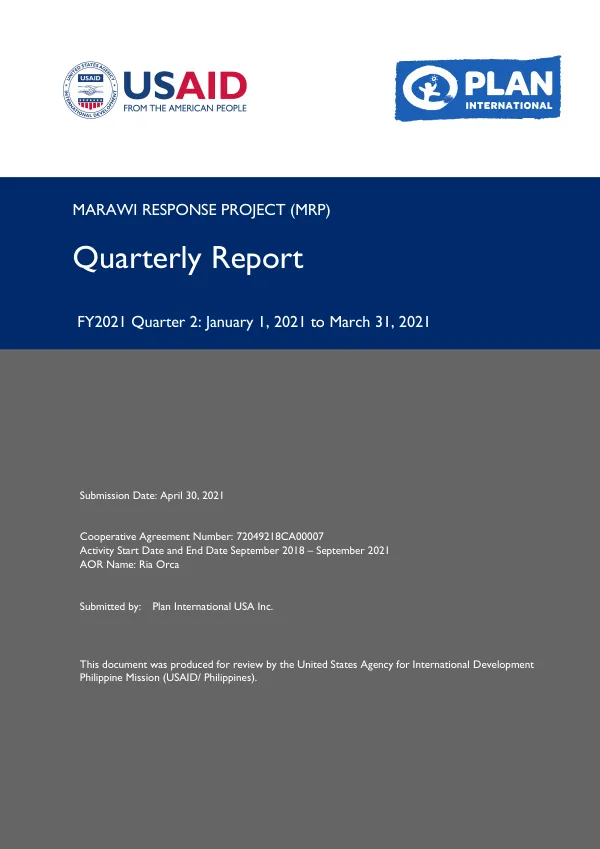
Marawi Response Project (MRP) Quarterly Report FY2021 Quarter 2: January 1, 2021 to March 31, 2021
Sign inEQUAL ACCESS INTERNATIONAL
Marawi Response Project (MRP) Quarterly Report FY2021 Quarter 2: January 1, 2021 to March 31, 2021
The Marawi Response Project (MRP) continued implementation in the second quarter of Fiscal Year 2021, despite challenges posed by the COVID-19 pandemic.
2021 · 45 pages
Sign in to readA free account is required to download.
Abstract
A total of 45 grants were delivered in the quarter, with 36 under Intermediate Result (IR) 1 and 9 under IR 2. As of March 2021, 693 grants, or 98% of the 709 grants with delivery requests to date, have been completely delivered and 347 (50%) of the 693 completed grants have been closed. Under IR 1, MRP completely delivered 22 business recovery micro-grants (BRGs) to 500 entrepreneurs and cooperative members, with half of the grants for tilapia production, computer services, and printing services. In addition, the 14 livelihood micro-grants delivered were complemented by workforce development training, with a total of 464 individuals trained, a completion rate of 98.5%. Almost two thirds of the trainees, or 64%, were youth, 29 years old and younger. Trainings covered a range of topics from technical skills development for the garment industry and small engine mechanic and vulcanizing, to agriculture and aquaculture. MRP maintained strong collaboration with governmental and private sector partners under IR 1. Notable examples this quarter include meeting with Local Government Units (LGUs) and conducting workshops on program priorities promoting economic development through priority value chains. MRP also met with the Department of Trade and Industry (DTI) on the Barangay Micro Business Enterprise (BMBE) Registration program, which will bring 21 Community Solidarity Groups (CSGs) from Iligan City towards institutionalization as micro and small businesses and serve as a test approach for other CSGs. Under IR 2, social cohesion interventions in Year 3 focused on strengthening CSGs to become active participants in governance and civic engagements. In Q2, MRP issued micro-grants for community improvement and community engagement that would strengthen democratic participation and promote peace building. Nine social cohesion grants were delivered, including community learning facilities and community engagement grants for awareness raising and advocacy campaigns on gender equality and fighting Gender Based Violence (GBV), and for strengthening referral services pathways of the LGUs. As of the end of Q2, MRP has delivered social cohesion grants with an anticipated reach of 30,419 individuals for Year 3, in the Municipalities of Baloi, Bubong, Lumbayanague, Marantao, and Pantao Ragat. IR 2 training during the reporting period focused on peace and conflict, community peace building in a Peace Champions 'Boost' Camp, community engagement and facilitation processes, and the community scorecard process. A Peace Fellows Training and Mentorship program was conducted with partner Equal Access International with stipends provided to Fellows following the training by Plan International USA. ECOWEB carried out training aimed at strengthening community actions and promoting Internally Displaced Person (IDP) rights protection dialogues in the context of the COVID-19 pandemic in LDS and LDN. This quarter, MRP also began implementing the plan developed in Q1 to address Gender-based Violence (GBV). A strategic partnership was formed with the Joint Child Protection & Gender-Based Violence Working Group, a broad-based coalition committed to raising awareness of the harm of GBV, preventing GBV from occurring, and supporting survivors of GBV. The Working Group began conducting a Rapid Gender Assessment (RGA) in LDS to collect and analyze data highlighting the gendered experience of communities, women, and other vulnerable groups. MRP continued to collaborate with various stakeholders, including the Department of Trade and Industry (DTI), Local Government Units (LGUs), and Community Solidarity Groups (CSGs), to promote economic development and social cohesion in the target areas. The project's focus on business recovery, livelihood development, and social cohesion interventions aimed to address the needs of the affected communities and promote peace building in the region.