USAID DEC
FY14 Q2 Report: Stabilizing Vulnerable Communities in the Central Africa Republic through the Promotion of Intercommunity Dialogue and Economic Cooperation
Sign inCATHOLIC RELIEF SERVICES ORGANIZATION
FY14 Q2 Report: Stabilizing Vulnerable Communities in the Central Africa Republic through the Promotion of Intercommunity Dialogue and Economic Cooperation
The Stabilizing Vulnerable Communities in the Central African Republic through the Promotion of Intercommunity Dialogue and Economic Cooperation (SVC) program began in January 2014 with the goal of addressing the accelerating violence in the Central African Republic by providing mechanisms for peaceful resolution of inter-community conflicts.
2014 · 13 pages
Sign in to readA free account is required to download.
Abstract
The program aims to work with community leaders to build their capacity to peacefully resolve inter-communal disputes, work together on projects of mutual interest, and promote tolerance. Implementation of the SVC program was delayed due to various setbacks, including the recruitment of a Conflict Advisor, which was challenging due to international media coverage on the significant rise of violence in the Central African Republic. Despite these delays, the Country Director and Deputy Country Director began networking with local authorities, major religious platforms, and local CSOs to lay the foundation for implementation. Mercy Corps also began coordination meetings with partner INGOs, such as Catholic Relief Services (CRS), Search for Common Ground (SFCG), and other organizations with social cohesion programs. During this period, Mercy Corps established a firm foundation for the launch of a strong social cohesion program in Bangui and Bouar. The program has recruited a Conflict Mitigation Advisor, a SVC Program Manager, and a Monitoring and Evaluation Manager. Recruitment for local staff has started, including M&E Officers, Program Assistants, Program Facilitators, Community Level Supervisors, and Drivers for both Bangui and Bouar offices. A rapid questionnaire was designed as part of the baseline survey, and five surveyors were trained and conducted the survey in Bouar in preparation for the main start-up assessment. The SVC program is focusing on strengthening the capacity of local communities to manage conflict and insecurity, thereby building their resilience to future instability. The program is promoting attitudes of tolerance and non-violence through support of inter-community peace messaging. Community and religious leaders, youth, women, and local authorities have confirmed an understanding of project objectives and activities and expressed their commitment to support project activities and work with Mercy Corps. The security situation in the Central African Republic remains volatile, with tensions and deadly violence continuing throughout the country. Much of the continued violence can be attributed to the existence of non-state militias and the uncertain status of the Forces Armées de Centrafrique (FACA). Ex-Seleka forces have left the capital and are situated in the north and north-east, remaining a major threat to long-term stability. An estimated 600,000 persons remain in IDP camps or in the bush, including 200,000 in Bangui. Many Muslims continue to express the desire to leave the Central African Republic because they do not feel adequately protected by peacekeepers. Mercy Corps has established a coordination mechanism with partner organizations, including SFCG, CRS, and DRC, to ensure effective and efficient intervention, avoiding duplication or conflicting purposes or messaging. Partners share the details of the various social cohesion projects, including areas of intervention, target population, and types of activities. This coordination effort will continue during the next quarter. Mercy Corps has also become a member of the Livelihood and Community Stabilization (Social Cohesion) Cluster, which is primarily concerned with sharing information on activities and for future planning, as well as possible partnerships and security matters to report to UN and Government of CAR (GoCAR).
Related documents
Documents in this collection
 2014
2014USAID DEC
FY14 Q3 Quarterly Report: Stabilizing Vulnerable Communities in the Central African Republic through the Promotion of Interfaith Dialogue and Economic Cooperation
Open record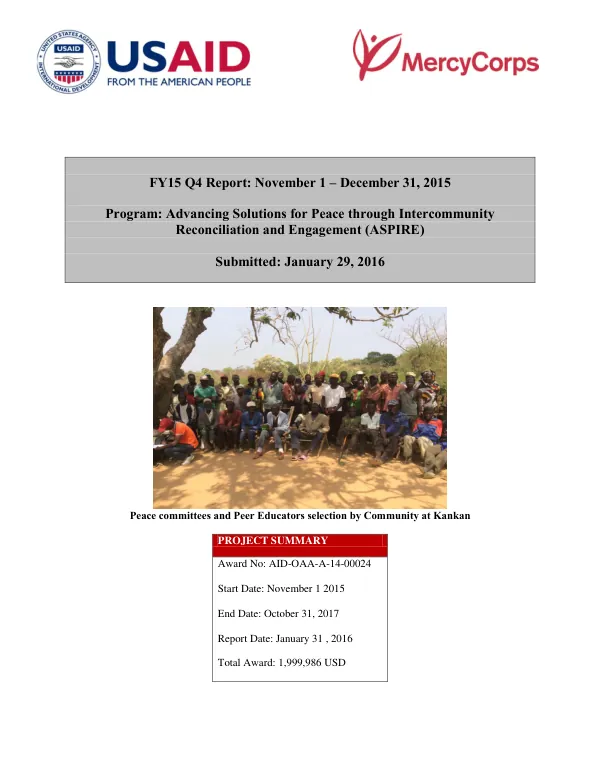 2016
2016USAID DEC
FY15 Q4 Report: Advancing Solutions for Peace through Intercommunity Reconciliation and Engagement (ASPIRE)
Open record