INTERNATIONAL NGO SAFETY ORGANISATION
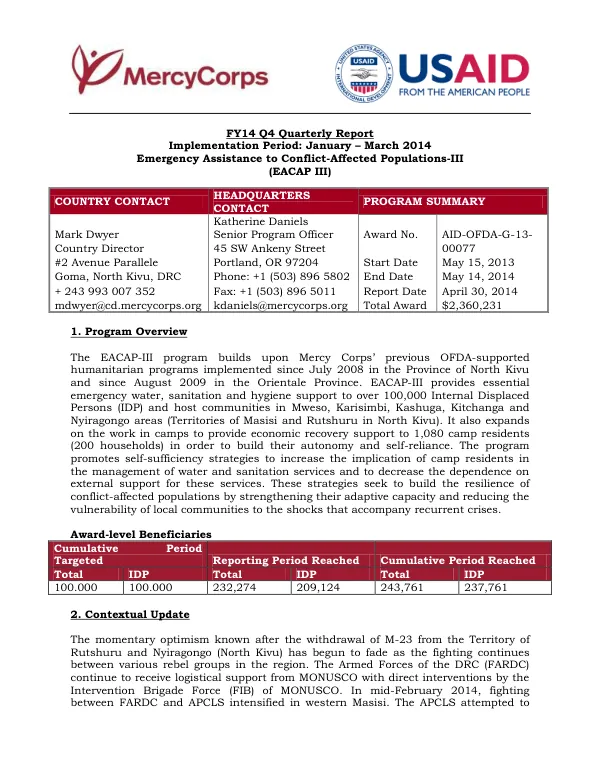
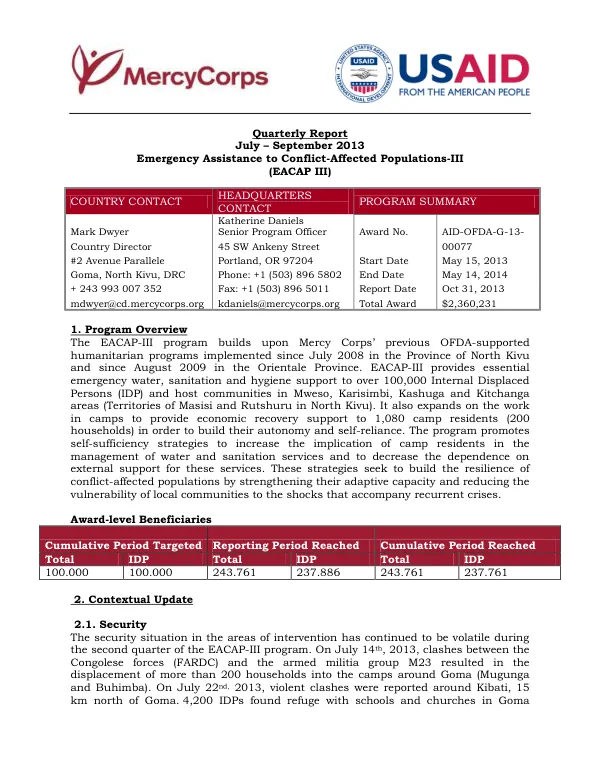
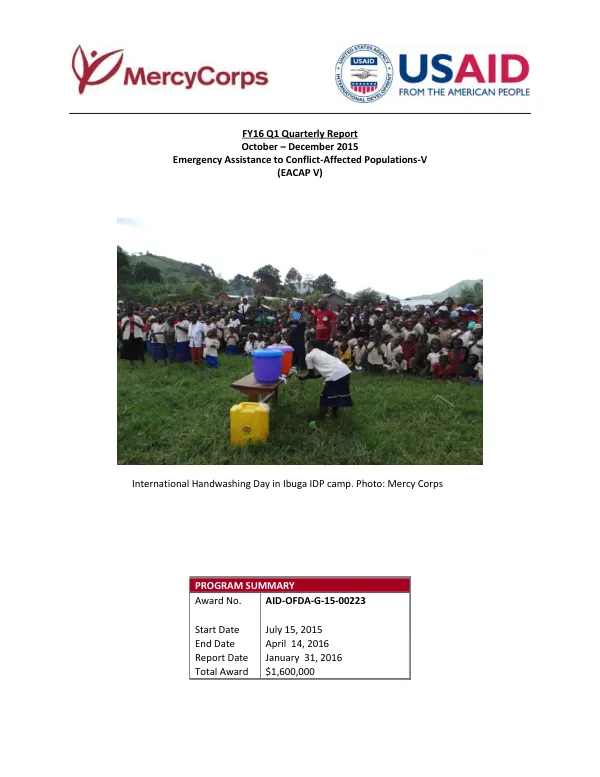
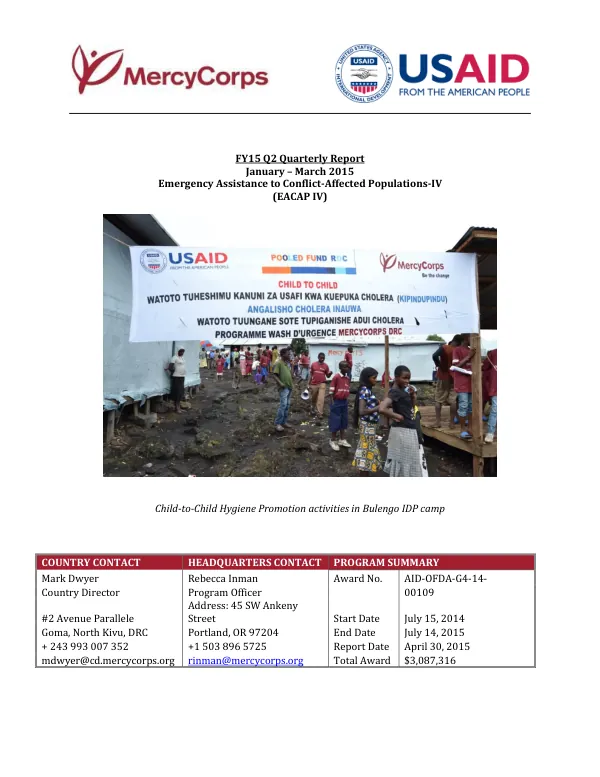
FY15 Q2 Quarterly Report: Emergency Assistance to Conflict-Affected Populations-IV
Emergency Assistance to Conflict-Affected Populations-IV (EACAP-IV) is a 12-month emergency response program operating in 21 Internally Displaced Person (IDP) camps and their host communities in Mweso-Birambizo and Karisimbi Health Zones, North Kivu Province.
2015 · 11 pages
Sign in to readA free account is required to download.
Abstract
The program comprehensively responds to the Water, Sanitation and Hygiene (WASH) needs of conflict-affected populations in order to reduce mortality and morbidity related to water-borne illnesses. The program also supports the international NGO INSO, whose mandate is to assist humanitarian aid organizations in fulfilling their missions through the provision of essential security cooperation and information services. During the third quarter of the project, Mercy Corps continued supplying potable water to 21 IDP camps through pumping and treatment systems, gravity-fed water systems and spring catchments. Mercy Corps constructed and rehabilitated sanitation facilities in camps, primarily in Mweso area, ensuring that the displaced population has continued access to a safe and clean environment. The program also participated in coordination meetings such as the WASH Cluster and the CCCM working group in Goma, and the weekly inter-agency meetings in Kitchanga, in order to gather information and address emergency needs in a timely manner. Through a partnership with International NGO Safety Organisation (INSO), the program ensures that humanitarian partners working in North and South Kivu are able to access and use accurate security information, which ultimately increases the impact of Mercy Corps and its diverse partners operating in conflict-affected environments. The program covers a wide range of services, both scheduled and requested, to help assist the humanitarian organizations in fulfilling their own mandates through the provision of essential security cooperation and information services. Persistent conflict in the North Kivu region of Eastern Congo continues to negatively impact the lives of thousands of civilians. An estimated 139,625 IDPs currently reside in the 21 camps which Mercy Corps operates, and these camps still require extensive external support due to their steady growth. Overall, the current provision of services in and around the camps is not adequate to meet the needs of the displaced and of the host populations. Furthermore, movements of populations remain unpredictable due to the intense and continuous fighting among armed groups. Cholera is endemic to the region, and inadequate sanitation infrastructure and hygiene practices increase the risk of outbreak. In response to this chronic emergency, Mercy Corps continues to provide essential WASH services in IDP camps in North Kivu, preventing the spread of cholera. The security context in North Kivu has been complicated in the first three months of 2015, with military operations against FDLR and other armed groups launched by the FARDC. The collaboration between the army and the MONUSCO for these operations is still on stand-by due to the appointment of two generals at the head of operations in the east whom the MONUSCO considers unfit as they have human rights violation records. Despite numerous operations which are ongoing against the armed groups, their activities continue to increase in some areas and at least one armed group is present in each territory of North Kivu (with the exception of Idjwi territory and low numbers of incidents reported in Nyiragongo, Kalehe and Walungu). The MONUSCO mandate was extended for another year until March 2016, with similar priorities to that of the previous mandate and an emphasis on support to the implementation of the Peace, Security and Collaboration Framework, of which the security sector reform is an integral part. The political context has been lively in the first three months of the year, with popular demonstrations intensified during January after an attempt to pass a law changing the electoral code was introduced to the National Assembly by the Presidential majority. The civil society, youth groups and the opposition parties took to the streets in Kinshasa, Goma, Bukavu and other large provincial capitals. This is the first time in DRC that a popular uprising was able to change the course of legislation: the National Assembly withdrew the changes opposed in the electoral code. Following this, from February onwards other demonstrations and sit-in protests were organized in Kinshasa and Bukavu, predominantly by one of the leading opposition parties, as their leader was put on trial again from a previous court case which had previously been finalized in 2011. The sympathizers of this party fear that their leader will be disqualified from the presidential race with this court case pending and therefore will continue their protests until the issue is resolved. In this context and especially in the face of major ambush and kidnapping risks, NGOs are finding it difficult to access all the areas that require their presence. Although the major security risk for the NGOs is armed robberies on the roads and in the premises, particularly during off-duty hours, the possibility of kidnapping NGO workers against ransom is also a concern. During the first quarter of 2015, 55 incidents against the NGOs were reported in the two provinces that INSO covers. The main type of incident affecting NGO security was criminal acts, which represented 73% of all incidents recorded. Of these,