USAID DEC
FY16 Q1 Quarterly Report Emergency Assistance to Conflict-Affected Populations-V (EACAP V)
Sign inMERCY CORPS INTERNATIONAL
FY16 Q1 Quarterly Report Emergency Assistance to Conflict-Affected Populations-V (EACAP V)
The Emergency Assistance to Conflict-Affected Populations-V (EACAP V) program in North Kivu, Democratic Republic of the Congo, aimed to provide essential emergency assistance to conflict-affected populations through the provision of water, sanitation, and hygiene (WASH) services.
2016 · 9 pages
Sign in to readA free account is required to download.
Abstract
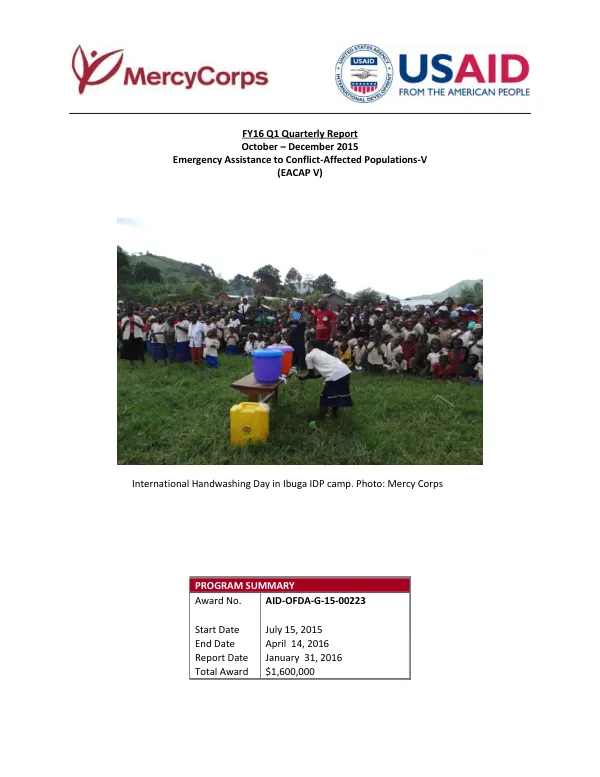
The program targeted approximately 125,000 people, including 100,000 individuals living in 30 internally displaced person (IDP) camps, addressing their most critical WASH needs. During the reporting period of October to December 2015, Mercy Corps continued to ensure access to clean drinking water and sanitation facilities in 19 IDP camps in accordance with North Kivu WASH Cluster standards. The organization provided hygiene promotion support to approximately 117,125 IDPs in the Mweso and Karisimbi Health Zones. Mercy Corps constructed and rehabilitated 300 latrines and 104 bathing facilities and treated and sealed full latrines in 19 camps. The WASH team conducted hygiene promotion activities in all 19 camps through an awareness-raising campaign, including door-to-door visits and community theater, focus group discussions conducted weekly in the camps, and the dissemination of hygiene messages through a local radio station. In response to a cholera outbreak in four of the camps, Mercy Corps supported the Rapid Response Teams (RECOs) to conduct a campaign on the five critical moments for hand washing and distribute soap to 925 families. Mercy Corps continued Community-Led Total Sanitation (CLTS) activities in Mbuhi, Kalonge, and Katahandwa villages, conducting 261 door-to-door visits, 207 meetings on the consequences of open defecation, the causes of diarrhea diseases, and methods of prevention, benefiting 2,229 people in total. The communities of these three villages built 164 latrines in total, including 115 new latrines and 49 existing latrines repaired. The program's achievements during the reporting period included providing an overall average of 23 liters of clean water per person per day, exceeding the North Kivu WASH Cluster standard of 10 liters per person per day and the SPHERE standard of 15 liters per person per day. Mercy Corps also managed a water pumping, treatment, and distribution station serving Bulengo, with a capacity of 70,000 liters per day. In terms of sanitation infrastructure, Mercy Corps constructed and rehabilitated 300 latrines and 104 bathing facilities, and treated and sealed full latrines in 19 camps. The program aimed to maintain or exceed the ratio of 38 people per latrine, which was achieved during the reporting period. Mercy Corps regularly carried out weekly random water testing at household and water point levels in the camps around Goma to ensure quality control of water. The program's performance summary highlighted the achievements during the reporting period, including the provision of clean drinking water, sanitation facilities, and hygiene promotion support to IDP camp communities. The program's staff used vehicles purchased through USAID/OFDA funding for all movements, while transport of materials to the field was carried out using a rental truck. Mercy Corps continued to work with the humanitarian community to advocate for the rights of displaced populations and against the rapid closure of other camps in North Kivu.