MERCY CORPS INTERNATIONAL
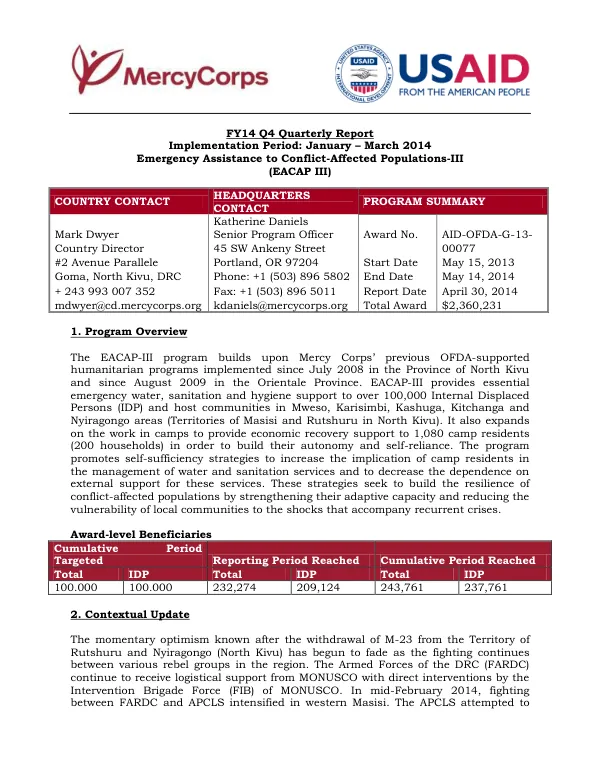
Second Quarterly Report: Emergency Assistance to Conflict-Affected Populations-III
The EACAP-III program is a humanitarian initiative that aims to provide emergency assistance to conflict-affected populations in the North Kivu Province of the Democratic Republic of Congo.
2013 · 11 pages
Sign in to readA free account is required to download.
Abstract
The program is implemented by Mercy Corps, a non-governmental organization, and is funded by the United States Agency for International Development (USAID). The program's primary objective is to address the humanitarian needs of over 100,000 internally displaced persons (IDP) and host communities in the Masisi and Mweso areas. The program focuses on providing essential emergency water, sanitation, and hygiene (WaSH) support to the affected populations. This includes the construction of sanitation facilities, provision of water through trucking, pumping, and treatment systems, and the repair and maintenance of existing infrastructure. Mercy Corps' community mobilizers also conduct post-distribution monitoring to ensure that hygiene kits are being used effectively and that hand washing stations are filled with water. In addition to WaSH support, the program also provides economic recovery and livelihood support to IDP communities. This includes the establishment of vulnerability criteria and the selection of beneficiaries for livelihood activities. In the Mweso Health Zone, 18 households (approximately 80 persons) were selected for economic recovery activities. The program has achieved several key achievements in the second quarter of 2013. These include the provision of emergency WaSH assistance in 16 IDP camps and five spontaneous camps around Goma. The program has also constructed 592 new latrines, rehabilitated 771 existing latrines, and distributed 305 latrine maintenance kits to camp directors. However, the program has also faced several challenges. These include the problem of space for the construction of new infrastructure, which has slowed down activities. Camps located on volcanic soil or marshy ground have been particularly challenging to work with. Additionally, the program has faced challenges in reducing cholera cases, particularly in the Buhimba camp. The program has also conducted several awareness-raising activities to promote hygiene and sanitation practices among the affected populations. These activities have included weekly hygiene promotion sessions, dissemination of radio messages, and the distribution of soap and other hygiene materials. In terms of performance, the program has achieved several key indicators. These include a 27% increase in the number of IDPs served, a 25% increase in the number of households benefiting from WaSH activities, and a 20% increase in the number of households benefiting from economic recovery activities. The program has also conducted several assessments to measure the impact of the EACAP-III program. These assessments have included a baseline survey, which has provided data on the humanitarian needs of the affected populations. The program has also conducted a midterm evaluation, which has provided data on the program's progress and achievements. Overall, the EACAP-III program has made significant progress in addressing the humanitarian needs of conflict-affected populations in the North Kivu Province. However, the program continues to face several challenges, including the problem of space for the construction of new infrastructure and the reduction of cholera cases.