USAID
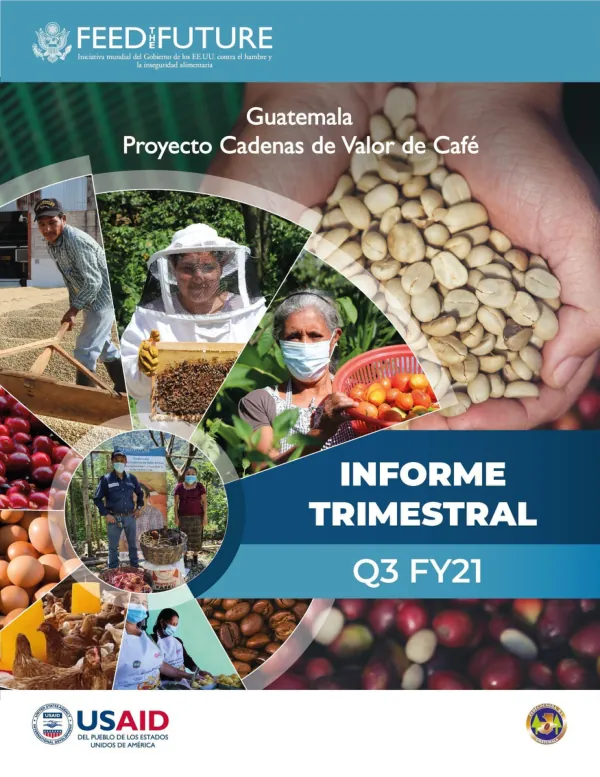
FY2021 Third Quarterly Progress Report of the Coffee Value Chains Project
The Coffee Value Chains Project in Guatemala aims to improve levels of economic growth and social development in the Western Highlands.
2021 · 58 pages
Sign in to readA free account is required to download.
Abstract
The project is implemented by the Federación de Cooperativas Agrícolas de Productores de Café de Guatemala, Responsabilidad Limitada (FEDECOCAGUA, R. L.) and is funded by the United States Agency for International Development (USAID) under the global Feed the Future initiative. The project's development objective is to improve agricultural productivity, expand markets, and improve nutrition. The project's main activities during the third quarter of FY2021 focused on expanding coverage, environmental compliance, gender and social inclusion considerations, capacity strengthening, and other relevant activities. The project expanded its coverage to more than 2,000 new households of small coffee producers, exceeding the annual goal by 47%. As of June 30, 2021, the accumulated growth in annual coverage was 6,746 households. The project also implemented 1,767 productive economic entrepreneurships, in which 1,442 women and 325 youth participate. These entrepreneurships aim to improve food production for family consumption and diversify productive activities that generate income to improve the family economy. The project also promoted income-generating activities through the Project Grants Fund, providing technical assistance and training to implement projects in areas such as climate adaptation, post-harvest management of coffee, and renewable energy. The project's progress in meeting its objectives and goals includes improved agricultural productivity, diversified income generation alternatives, and expanded access to markets. The project also increased resilience through climate-smart and nutrition-sensitive agriculture practices. The project's management is overseen by FEDECOCAGUA, R. L., with support from USAID. The project's lessons learned include the importance of environmental compliance, gender and social inclusion considerations, and capacity strengthening. The project also identified risks and mitigation measures, including the need for continued support from USAID and other stakeholders. The project's main activities for the next quarter include continuing to expand coverage, implementing environmental compliance measures, and promoting income-generating activities. The project's financial report shows that the total federal funds allocated to the project are US$ 19,000,000. The project's financial report also includes a summary of the financial transactions and a statement of the project's financial position as of June 30, 2021. The project's success stories include the inauguration of the Camojá Complex, which was made possible by the production and productivity increase of the Huehuetenango coffee cooperatives supported by the project. The project also achieved significant results in terms of increased coffee production, improved food production for family consumption, and diversified productive activities that generate income to improve the family economy. The project's geographic focus is on the Western Highlands of Guatemala, with a specific focus on the departments of Huehuetenango, Quiché, and San Marcos. The project's population coverage includes 15,000 participants, with 35% women and 15% youth. The project's subject coverage includes agricultural productivity, diversification of alternatives for income generation, access to markets, and climate-smart and nutrition-sensitive practices.