USAID
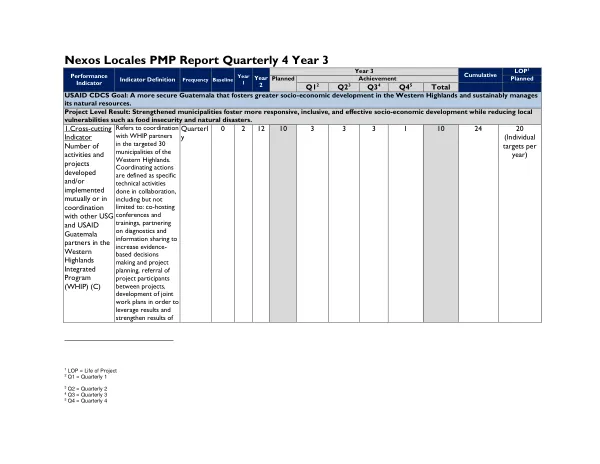
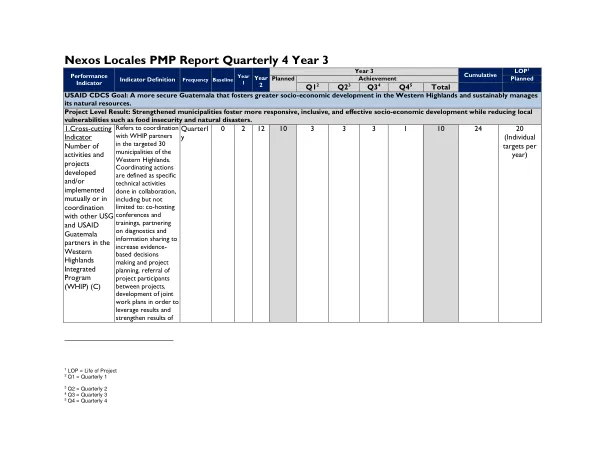
Nexos Locales PMP Report Quarterly 4 Year 3
The Nexos Locales PMP Report Quarterly 4 Year 3 outlines performance indicators for the USAID-funded project in Guatemala's Western Highlands.
2018 · 35 pages
Sign in to readA free account is required to download.
Abstract
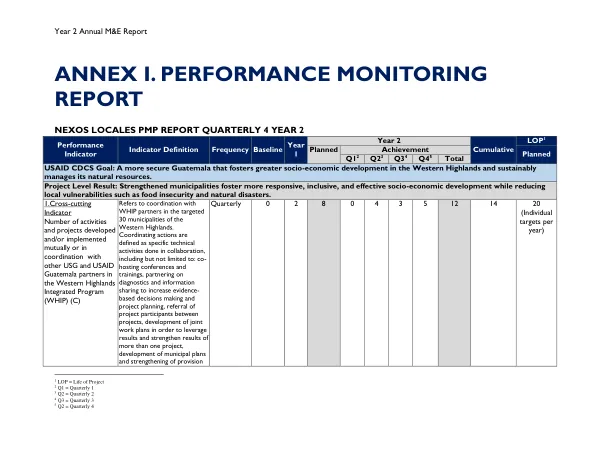
The project aims to strengthen municipalities and foster socio-economic development while reducing local vulnerabilities. The report focuses on seven performance indicators, which are categorized into three main areas: cross-cutting indicators, civic participation, and youth development. Cross-cutting indicators include the number of activities and projects developed and/or implemented in coordination with other USG and USAID Guatemala partners in the Western Highlands. The target for this indicator is to achieve 24 activities and projects by the end of Year 3. As of Quarter 4, Year 3, a total of 24 activities and projects have been achieved, exceeding the target. Another cross-cutting indicator is the number of USG-supported activities designed to promote or strengthen the civic participation of women. The target for this indicator is to achieve 30 activities by the end of Year 3. As of Quarter 4, Year 3, a total of 31 activities have been achieved, exceeding the target. Youth development is a key area of focus for the project, with a target to engage 600 youth in leadership roles within their communities by the end of Year 3. As of Quarter 4, Year 3, a total of 771 youth have been engaged in leadership roles, exceeding the target. The report also tracks the number of accountability presentations made by municipalities, with a target to achieve 64 presentations by the end of Year 3. As of Quarter 4, Year 3, a total of 101 presentations have been made, exceeding the target. In addition, the report tracks the number of individuals who received USG-assisted training, including management skills and fiscal management, to strengthen local government and/or decentralization. The target for this indicator is to achieve 3100 individuals by the end of Year 3. As of Quarter 4, Year 3, a total of 3603 individuals have received training, exceeding the target. The report also highlights the number of projects presented and/or prioritized by municipalities in coordination with communities/civil society, with a target to achieve 625 projects by the end of Year 3. As of Quarter 4, Year 3, a total of 860 projects have been presented and/or prioritized, exceeding the target. Finally, the report tracks the number of municipalities that practice participatory planning and budgeting, with a target to achieve 25 municipalities by the end of Year 3. As of Quarter 4, Year 3, a total of 25 municipalities have achieved participatory planning and budgeting, meeting the target. The report also provides disaggregated data on the performance indicators by gender, ethnic group, and age group. The data shows that women and youth have been disproportionately engaged in the project's activities, with 53% of participants being women and 40% being youth. The data also shows that Maya and Ladino ethnic groups have been the most engaged in the project's activities, with 62% and 41% of participants respectively. Overall, the report highlights the project's progress in achieving its performance indicators and demonstrates its commitment to strengthening municipalities and fostering socio-economic development in Guatemala's Western Highlands.