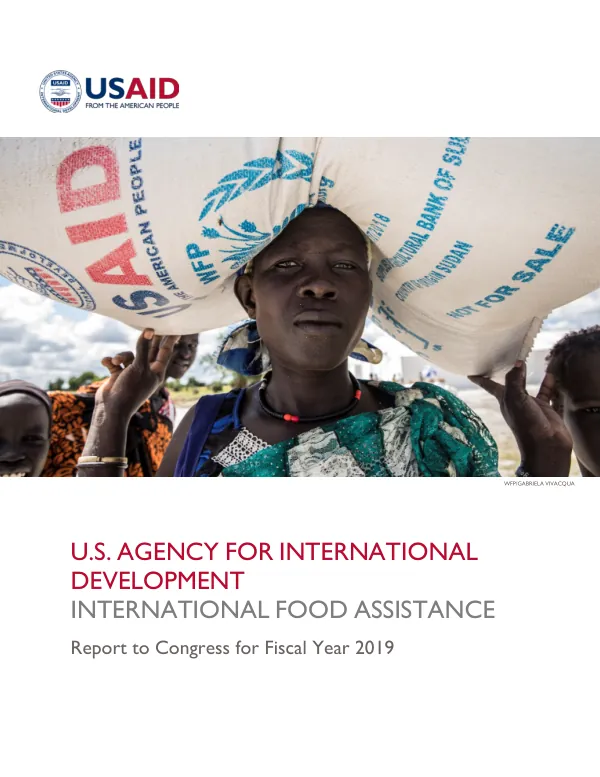
THE WORLD FOOD PROGRAMME
USAID FY 2019 EFSP REPORT
The Global Food Security Act of 2016 reauthorized the Emergency Food Security Program (EFSP) as a key component of the U.S.
2019 · 20 pages
Sign in to readA free account is required to download.
Abstract
Agency for International Development's (USAID) humanitarian assistance efforts. The program aims to mitigate the effects of manmade and natural disasters by utilizing innovative approaches to delivering aid that support affected persons and communities, build resilience and early recovery, and reduce opportunities for waste, fraud, and abuse. In FY 2019, USAID provided more than $2.4 billion in EFSP assistance, which reached over 39 million people in 50 countries. The program used market-based modalities, including local, regional, and international procurement (LRIP), cash transfers for food, and food vouchers. LRIP accounted for nearly 45 percent of EFSP funding, food vouchers 27 percent, and cash transfers nearly 23 percent. Essential complementary investments and other related activities accounted for the remaining five percent of EFSP funds. The EFSP played a critical role in addressing acute hunger and food insecurity in emergency situations around the world. In FY 2019, the Famine Early-Warning Systems Network (FEWS NET) estimated that 85 million people needed some level of emergency food assistance. The program's efforts were particularly crucial in responding to large-scale conflicts, such as those in Syria and the Republic of South Sudan, as well as climatic shocks or extreme weather patterns, such as the severe drought in the Horn of Africa. In South Sudan, the EFSP contributed more than $375 million in emergency food assistance, including $262 million in IDA funds and $114 million in Title II emergency funds. The program used multiple types of responses, including LRIP, cash transfers for food, and food vouchers, to meet the urgent food needs of multiple population groups throughout the country. In Cox's Bazar District, Bangladesh, the EFSP contributed more than $123 million in emergency food assistance, using IDA funds, for vulnerable populations, including Rohingya refugees. The use of IDA for LRIP in South Sudan increased efficiencies in both cost and time, with savings of 18 percent of costs compared to procurement under Title II and reduced delivery time by approximately three months. The EFSP's efforts in FY 2019 demonstrated the program's effectiveness in addressing acute hunger and food insecurity in emergency situations, and its continued importance in humanitarian assistance efforts around the world. The EFSP's geographic focus was global, with activities implemented in 50 countries. The program's timeframes were FY 2019, with a focus on addressing acute hunger and food insecurity in emergency situations. Recommendations for future programming include continued support for market-based modalities, such as LRIP, and the use of cash transfers for food and food vouchers to improve dietary diversity and reduce operational management of products.
Related documents