USAID DEC
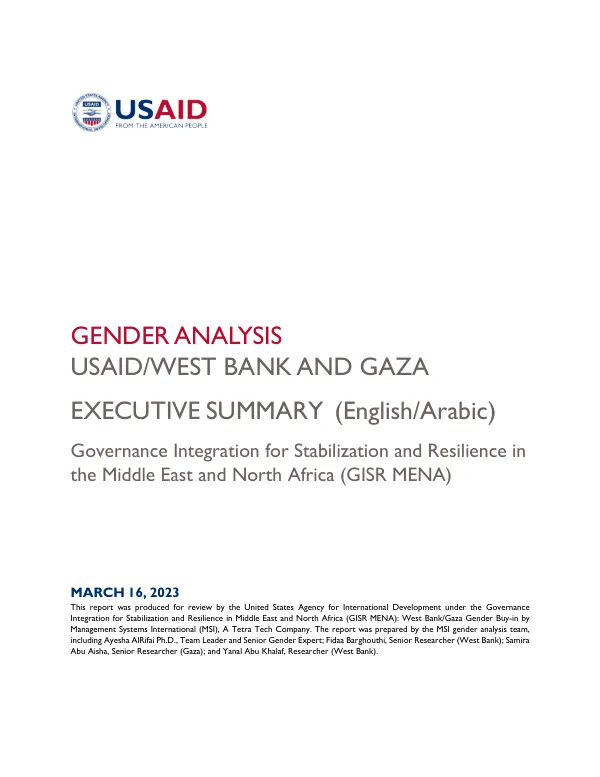
Gender Analysis for USAID/West Bank and Gaza: Governance Integration for Stabilization and Resilience in the Middle East and North Africa (GISR MENA)
Sign inMANAGEMENT SYSTEMS INTERNATIONAL
Gender Analysis for USAID/West Bank and Gaza: Governance Integration for Stabilization and Resilience in the Middle East and North Africa (GISR MENA)
The gender analysis for USAID/West Bank and Gaza identifies key gender inequalities, issues, and related constraints in the region.
2023 · 12 pages
Sign in to readA free account is required to download.
Abstract
The analysis examines the barriers and opportunities relevant to the rights and inclusion of women and members of other marginalized groups within priority sectors and subsectors of USAID/WBG's programming. The research team conducted a literature review, semi-structured key informant interviews, small group meetings, focus group discussions, and secondary data analysis of information and statistics. The analysis draws on quantitative data from secondary sources, primarily from the Palestinian Central Bureau of Statistics, the United Nations Women data portal, and the UN Office for the Coordination of Humanitarian Affairs' online digital services and platforms for current data and indicators. The analysis reveals that gaps in laws and policies, and in their implementation, leave women at risk. Many laws, regulations, and policies are without a gender perspective or sensitivity to women's rights and needs. Social norms considerably influence how women are regarded, respected, treated, and served in the home, the labor market, the workplace, in laws and policies, service delivery, and political discourse. Predominant norms include valuing women only for their reproductive capacity and their role as care providers, with disregard for women's economic and political leadership and potential. Gender-discriminatory behaviors are reinforced by social and political institutions, including religious bodies, the education system, and political parties. Resistance to inclusion, antifeminist discourse, religious narratives, and growing fundamentalism are among the social trends undermining gender equality. Deficiencies in resources and services prevent women from realizing their potential, and service providers from offering a full range of services that women, persons with disabilities, and others need to exercise their rights and potential. There is too little funding available from government and nongovernmental sources for opportunities and investments that would enable women to enhance their capabilities and increase their access to better services. Low awareness and sensitivity to women's rights, and the ways attitudes and behaviors lead to discrimination, harm, and exclusion, contribute to the perpetuation of inimical practices. This includes limited access to education, employment, and healthcare, as well as high rates of domestic violence, child marriage, and female genital mutilation. The research team makes recommendations for direct programming interventions and support that USAID can implement in collaboration with civil society, nongovernmental organizations, private sector actors, and international partners. The recommendations also include diplomatic efforts USAID might undertake to influence positive changes in laws, policies, and strategies, and their implementation, towards greater gender equality, inclusion, and equitable access to services in WBG. The Palestinian context is influenced by prolonged occupation and sociopolitical relations among Palestinian governing authorities. The social, political, and economic situation has deteriorated in recent years due to the coronavirus pandemic, the decline in peace prospects, and the severe security and economic conditions in the Gaza Strip. The territorial division of Palestinians along sociopolitical and geographic lines has undermined social cohesion between the West Bank and Gaza, and within the West Bank, which is divided into Areas A, B, and C, according to the treaty signed by the Palestinian Liberation Organization and Israel in 1993. Refugees registered by the United Nations Relief and Works Agency for Palestine Refugees in the Near East (UNRWA) accounted for approximately 41 percent of the total resident population in 2018. Approximately 64 percent of Palestinians in Gaza and 26 percent of Palestinians in the West Bank are refugees. Among the refugee population, 7 percent have at least one disability, and in 2017, 39 percent were living in poverty. The percentage of children with disabilities is 13.4 percent in the West Bank and 10.8 percent in the Gaza Strip (Palestinian Bureau of Statistics 2020).