SOCIAL IMPACT, INC.
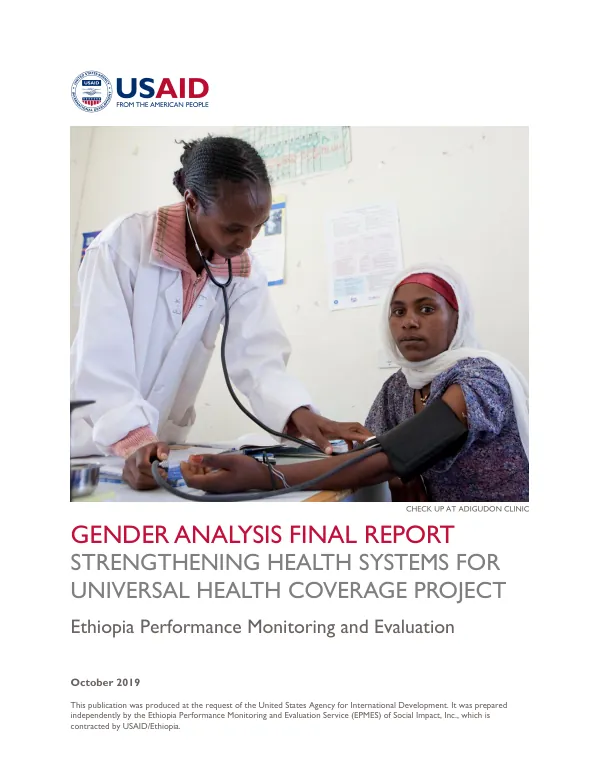
Gender Analysis: Strengthening Health Systems for Universal Health Coverage Project
The Strengthening Health Systems for Universal Health Coverage Project in Ethiopia aims to advance universal health coverage by developing robust quality health systems.
2019 · 25 pages
Sign in to readA free account is required to download.
Abstract
The project is designed to support the USAID/Ethiopia 2019-2024 Country Development Cooperation Strategy. The project's purpose is to improve health systems in Ethiopia, which are constrained by systemic factors such as limited availability of well-trained health providers, poor health infrastructure, budgetary constraints, and limited private health sector. The project's design focuses on strengthening human resources, expanding health financing options, and increasing health commodity and essential drug availability. The project also aims to enhance policy, governance, and evidence-based decision-making to improve health systems. Despite previous interventions, Ethiopia's health system is not yet strong enough to respond to the huge demand for health services and to track the outcomes of health systems strengthening interventions. A standardized system for monitoring health financing information and results is lacking, and regional health systems advocacy capacity is still weak. Issues of health system efficiency, equity, and service quality continue to pervade the health system due to inadequate human, material, and financial resources. The project requires deliberate strategies for addressing gender inequalities and female empowerment in Ethiopia. USAID's Gender Equality and Female Empowerment Policy recognizes the importance of advancing these issues for "the realization of human rights" and "effective and sustainable development outcomes." The gender analysis was designed to inform the Project Appraisal Document (PAD) for the HSS Project in line with Automated Directives System (ADS) 205 requirements. The analysis identified design priorities and considerations for the project, addressing issues such as gaps in participation by gender, potential priority areas for intervention, and potential risks and differential effects with approaches for addressing gender inequalities. The project's design focuses on addressing key inequalities among genders, focusing on women and men, and girls and boys. The analysis noted good practices from Ethiopia or worldwide to address these areas. The project aims to support the Government of Ethiopia in improving health systems, which is essential for achieving universal health coverage. The project's success requires deliberate strategies for addressing gender inequalities and female empowerment in Ethiopia. The project's implementation will involve strengthening human resources, expanding health financing options, and increasing health commodity and essential drug availability. The project will also enhance policy, governance, and evidence-based decision-making to improve health systems. The project's impact will be measured through the improvement of health systems, increased access to health services, and improved health outcomes for women, men, girls, and boys in Ethiopia. The project's geographic focus is Ethiopia, and the project's context is the country's health system, which is constrained by systemic factors. The project's timeframes are not specified in the provided text, but the project is expected to be implemented over several years. The project's recommendations are not specified in the provided text, but the project's design focuses on addressing key inequalities among genders and supporting the Government of Ethiopia in improving health systems.