SOCIAL IMPACT, INC.
Gender Analysis: Effective Emergency Response Project
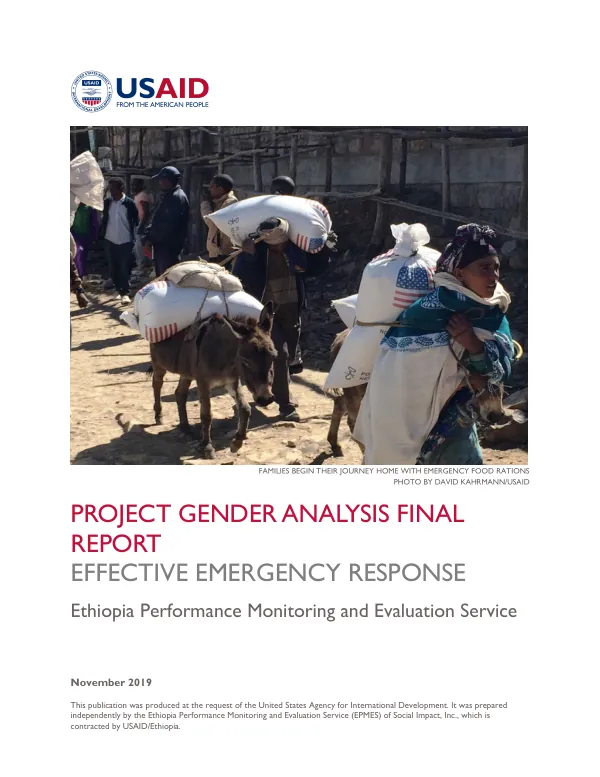
Displacement in Ethiopia as a result of natural disasters and conflict has risen over the past several years, accompanied by evolving government and international actor response mechanisms.
2019 · 29 pages
Sign in to readA free account is required to download.
Abstract
The number of people newly displaced by conflict in Ethiopia rose from 296,000 in 2017 to 1.7 million in 2018. As of 2019, Ethiopia has hosted 655,105 refugees, with 53 percent being women and girls. The Humanitarian Response Plan (HRP) Mid-Year Review, covering January 2019 to June 2019, notes that, of the 8.86 million people in need, only 7.93 million were reached. A funding deficit of $319 million still exists relative to projected needs. The most identified major needs are located in Oromia and Somali, two of the three regions with the most access incidents as a result of conflict. Ethiopia's first national prevention and preparedness strategies emerged between 1990-1994, marking the beginning of the reformed disaster management system in response to the growing frequency and magnitude of crop pests, floods, disease epidemics, and conflict. The National Disaster Risk Management Commission (NDRMC) has replaced the Department of Agriculture's Disaster Risk Management Food Security Sector at the national level. The Government of Ethiopia (GOE) has collaborated closely with international actors to develop a clearer response strategy. However, Doctors without Borders reports that, as Ethiopia has aligned more closely with global trends and linked emergency response with development priorities, its ability to respond to emergencies has been impacted. The GOE provided nearly 35 percent of the $828.6 million in monetary contributions for the Humanitarian Response Plan, all for food support. The remainder came from the international community to support drought, flood, measles, and cholera survivors, as well as the return of 2.1 million internally displaced persons (IDPs) to their homes. The Humanitarian Response Plan (HRP) Mid-Year Review highlights the need for a more effective emergency response in Ethiopia. The review notes that, despite the efforts of humanitarian partners, a funding deficit of $319 million still exists relative to projected needs. The GOE and international actors must work together to address the root causes of displacement and ensure that emergency response efforts are effective and sustainable. This requires a clear understanding of the gender dynamics at play in emergency response, including the roles and responsibilities of women and men, and the impact of emergencies on women's and girls' lives. The Gender Analysis: Effective Emergency Response Project aims to provide a comprehensive understanding of the gender dynamics in emergency response in Ethiopia. The project uses a framework that considers the laws, policies, regulations, and institutional practices that affect women's and men's lives, as well as the cultural norms and beliefs that shape their roles and responsibilities. The project also examines the access to and control over assets and resources, as well as the patterns of power and decision-making in emergency response. By understanding these dynamics, the project aims to inform the development of more effective emergency response strategies that address the needs of women and men equally.