SOCIAL IMPACT, INC.
Final Report: Citizen-Responsive Governance Project Gender Analysis
Ethiopia is at a turning point in its path toward gender equality.
2019 · 20 pages
Sign in to readA free account is required to download.
Abstract
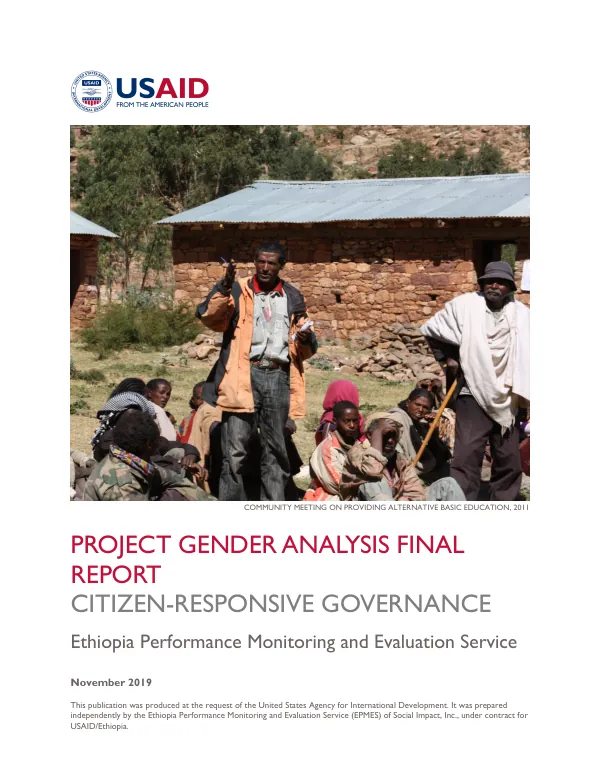
In 2018, women obtained top positions within the Government of Ethiopia (GOE). Women hold the presidency, Chief Justice of the Supreme Court, and 50 percent of Cabinet positions, including influential roles such as Minister of Defense and Minister of Peace. The GOE also recently passed laws and national action plans to address systemic gender issues in Ethiopian society, such as the 2020-2024 National Costed Plan to End Child Marriage and Female Genital Mutilation (FGM) and the 2019 Proclamation for Civil Society Organizations (CSOs), which allows CSOs receiving foreign funding to work on rights-based issues, including women’s rights. These moves signal that gender equality and female empowerment is a top priority at the highest levels of government and that the government is making important contributions to shifting long-held societal attitudes about women’s leadership and rights. Despite these encouraging markers of progress, gender equality remains out of reach for most Ethiopian women. Though appropriate legal frameworks are in place to protect the rights of women and girls, implementation is lacking, leaving women and girls vulnerable to various forms of gender-based violence (GBV). At least 40 percent of girls are married before the legal age of 18 and 10 percent of young women have been victims of domestic violence. Women face limited access to justice because of deeply held societal norms that discourage their speaking out and because of a lack of legal protections where customary traditions take precedence over national laws. The Citizen-Responsive Governance Project is intended to address the fact that governmental institutions are not adequately responsive and held accountable to citizen needs. Democratic institutions, civil society, and public and private media do not have the independence and capacity to advocate for and empower citizens. In response to these issues, the Citizen-Responsive Governance Project aims to support Ethiopia’s democratization by improving mechanisms for accountable governance and grievance redress. This will include working with the justice sector to improve rule of law and work with democratic institutions, civil society, and media to hold government institutions accountable to positively impact state-society relations and advancing responsive governance and democratization. The purpose of this gender analysis is to provide pertinent information for the USAID/Ethiopia Citizen-Responsive Governance Project Design Team to enable gender integration within its Project design and its Project Appraisal Document (PAD). The analysis identified design priorities and considerations for the Project, addressing issues such as gaps in participation by gender that may affect key results of the Project, potential priority areas for intervention, and potential risks and differential effects. The Citizen-Responsive Governance Project Design Team and USAID/Ethiopia’s Program Office, particularly the Mission Gender Advisor, are the intended key users of this report. The Gender Analysis Team used two primary data collection methods: a desk review of secondary sources containing qualitative and quantitative data and stakeholder consultations. The desk review was the primary mode of data collection for this analysis, and it involved a comprehensive review of existing literature, reports, and data on gender issues in Ethiopia. The stakeholder consultations involved meetings with key stakeholders, including government officials, civil society organizations, and community leaders, to gather information on gender issues and to validate the findings of the desk review.