USAID DEC
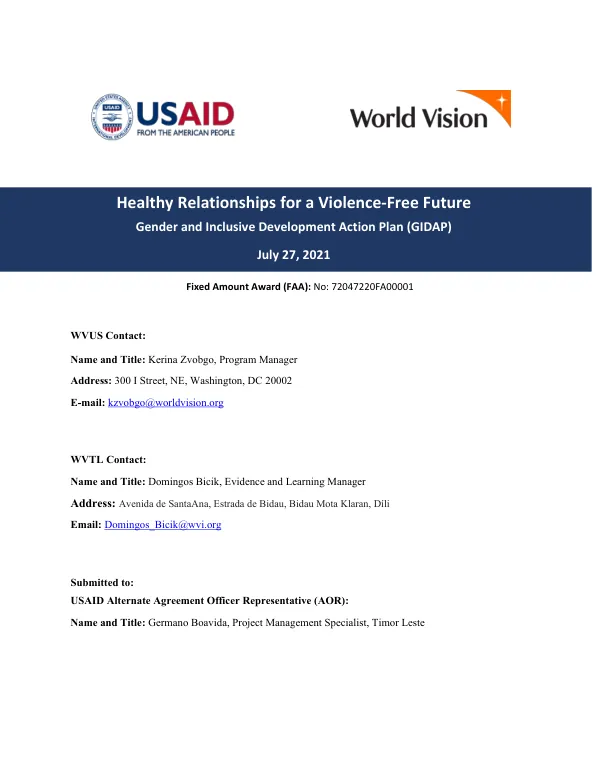
Gender and Inclusive Development Action Plan: Healthy Relationships for a Violence-Free Future
Sign inUSAID
Gender and Inclusive Development Action Plan: Healthy Relationships for a Violence-Free Future
The Healthy Relationships for a Violence-Free Future activity is an initiative implemented by World Vision Timor-Leste (WV-TL) with funding from the United States Agency for International Development (USAID).
2021 · 9 pages
Sign in to readA free account is required to download.
Abstract
The activity aims to promote healthy, non-violent relationships among intimate partners, between youth and their parents, and amongst youth in Timor-Leste. The initiative uses the People-to-People (P2P) reconciliation approach to address long-standing social divisions that impede peacebuilding efforts. The activity targets four strategic priority areas: prevention, services, access to justice, and coordination, monitoring, and evaluation. It focuses on promoting healthy relationships, encouraging positive behaviors among peers and family members, and connecting survivors of gender-based violence (GBV) to appropriate care and justice services. The initiative also aims to enhance GBV prevention and response at the local level. A Gender and Social Inclusion (GESI) analysis was conducted to identify gender and inclusion gaps and opportunities that the Healthy Relationships for a Violence-Free Future activity team will address. The analysis revealed that Covalima youth need pathways to pursue positive relationships that encourage harmonious gender relations with their peers and family members. Women and other vulnerable groups require safe access to protection and GBV response services, while parents/caregivers need support to demonstrate positive parenting/caregiving practices and gender equitable roles. The activity targets youth, parents, survivors of GBV, and GBV informal and formal prevention and response mechanisms in Covalima municipality. With youth, the initiative introduces life skills via the IMPACT+ model, which includes positive messaging, intrapersonal communication, negotiation, and conflict resolution skills, as well as training in gender and protection matters. For parents, training on caregiving and positive masculinities (Men Care approach) will be emphasized for young male parents, and networks and partnerships supportive of families will be encouraged and strengthened. The activity will also enhance/strengthen service providers' capacity in GBV prevention and response for survivors of GBV or those at risk for experiencing GBV. Woven through all are messages around gender equality and making the connection with GBV being rooted in gender inequalities, and that all actors play a role in ending GBV. The initiative recognizes the role of intersectionality, where exclusion or barriers to inclusion for those who hold membership in multiple vulnerability groups, can affect their engagement with the activity. The activity has several indicators and methods of verification, including baseline/endline surveys, routine monitoring, and output indicators. Outcome indicators include the proportion of adolescent females and males who have an increase in gender equitable attitudes, and the percentage of women whose parenting partners take responsibility on caregiving. Intermediate results include the percentage of men with increased household responsibilities, and the number of members of challenging or defying gender norms that emphasize women's focus in domestic/care work. The activity aims to create an enabling environment in which GESI transformative change is fostered and sustained, where individuals can establish healthy, positive relationships that flourish, and communities and societies can create structures to support these relationships. The initiative targets a wide range of populations and vulnerable groups, including youth, parents, survivors of GBV, and GBV informal and formal prevention and response mechanisms in Covalima municipality.