USAID DEC
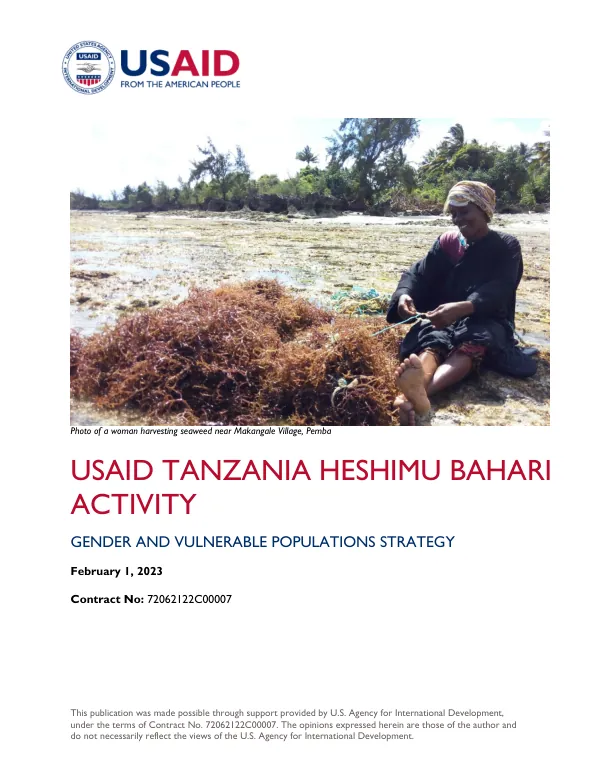
Gender and Vulnerable Populations Strategy for the USAID/Tanzania Heshimu Bahari Activity
Sign inCHEMONICS
Gender and Vulnerable Populations Strategy for the USAID/Tanzania Heshimu Bahari Activity
The USAID Heshimu Bahari Activity aims to strengthen the capacity for biodiversity conservation in Tanzania by reducing the use of illegal and unsustainable fishing, improving governance and management of coastal land and seascapes, and enhancing policy development and capacity to implement evidence-based, inclusive policies.
2023 · 52 pages
Sign in to readA free account is required to download.
Abstract
The project will conduct activities to support four complementary objectives: expanding a network of resilient Marine Protected Areas (MPAs), strengthening community co-management of MPAs and wild-caught fisheries, expanding private sector investment in MPAs and wild-caught fisheries, and integrating relevant science to MPA management. The Heshimu Bahari Activity will focus on four objectives, each with specific interventions to achieve marine conservation and sustain USAID's investments in Tanzania's blue economy. Objective 1 aims to expand a network of resilient MPAs, while Objective 2 seeks to strengthen community co-management of MPAs and wild-caught fisheries. Objective 3 targets private sector investment in MPAs and wild-caught fisheries, and Objective 4 focuses on integrating relevant science to MPA management. The Gender and Vulnerable Populations Strategy (GVPS) provides a foundation for Activity staff to leverage and amplify the essential role that women, youth, and other vulnerable groups play to advance marine conservation. The GVPS is guided by USAID's Gender Equality and Women's Empowerment 2020 Policy, USAID ADS 205, and USAID's Youth in Development Policy. The strategy focuses on underrepresented social groups whose access to, leadership in, and benefit from marine-based natural resources management is constrained due to socio-cultural factors. The GVPS identifies three key areas for consideration: unequal opportunities and ability to make decisions, influence, and exercise control over resources; unequal access to leadership roles and capacity to influence decision making; and limitations of young males and/or female traders to capitalize on trade and business opportunities in targeted regions. To address these challenges, Heshimu Bahari will take a three-pronged approach towards GESI integration, considering how Tanzanian women and youth serve as marine ecosystem beneficiaries, conservation stewards, and champions for sustainability. The Activity's theory of change posits that if enabled policy frameworks and government capacities to implement diverse pathways for marine conservation and fisheries management exist, and communities are empowered in MPA and fisheries management, and barriers to private sector investment are lowered, and scientific capacity, information, and influence are strengthened, then a diverse MPA network can be created and sustained to conserve biodiversity, enhance ecological resilience to climate change, and improve livelihoods and food security. Heshimu Bahari's Conceptual Inclusion Framework for GESI integration emphasizes the importance of considering the unique needs of the elderly, rural/poor households, and migrant fisher communities. The Activity will engage with diverse social groups to conserve marine biodiversity in Tanzania's seascapes, recognizing that engagement with underrepresented social groups is critical to the success and sustainability of the Activity. The GVPS will guide Heshimu Bahari's implementation throughout the Activity's five-year lifecycle, providing a foundation for staff to leverage and amplify the essential role that women, youth, and other vulnerable groups play to advance marine conservation and sustain USAID's investments in Tanzania's blue economy.
Related documents