CHEMONICS
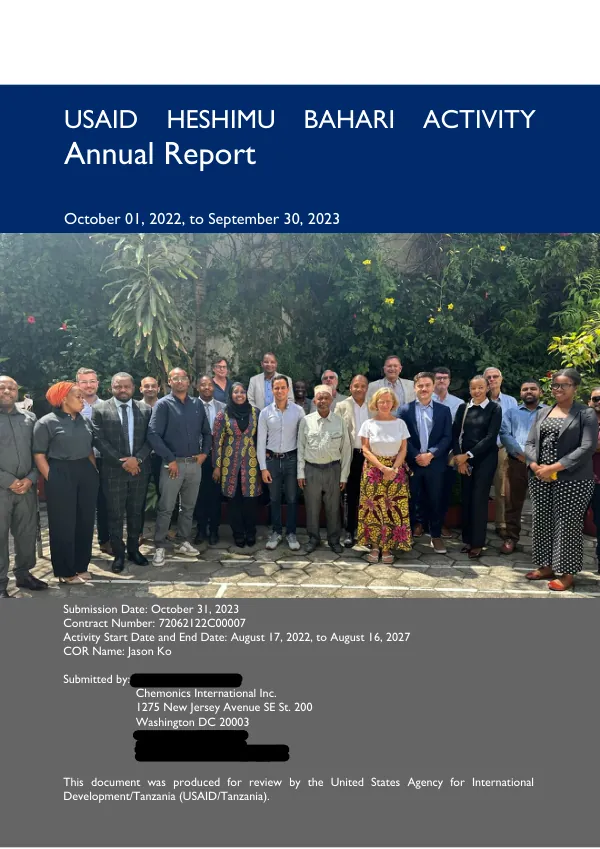
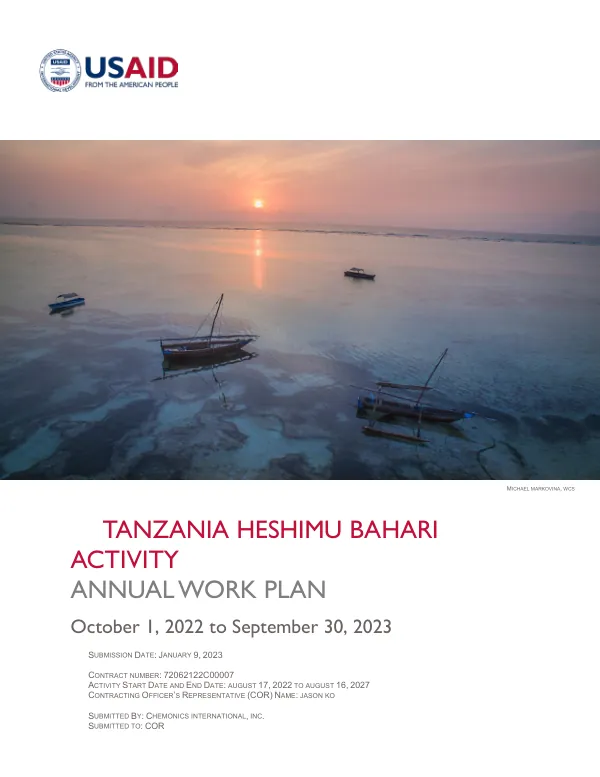
Heshimu Bahari Year 1 Annual Workplan
The Heshimu Bahari Activity is a five-year initiative aimed at promoting sustainable marine conservation and management in Tanzania.
2023 · 42 pages
Sign in to readA free account is required to download.
Abstract
The activity began on August 17, 2022, and is scheduled to conclude on August 16, 2027. The project is funded by the United States Agency for International Development (USAID) and is implemented by Chemonics International, Inc. The activity's primary objective is to strengthen the capacity of the Government of Tanzania to manage marine protected areas (MPAs) and no-take replenishment zones (NTRZs). This will be achieved through the expansion of a collaborative network of resilient MPAs and NTRZs, as well as the enhancement of community co-management of MPAs and wild-caught fisheries. To achieve these objectives, the activity will focus on four key areas: (1) expanding the collaborative network of MPAs and NTRZs, (2) strengthening community co-management of MPAs and wild-caught fisheries, (3) promoting private sector investment in MPAs and wild-caught fisheries, and (4) integrating relevant science into MPA management. The activity will work closely with various stakeholders, including government agencies, civil society organizations, and the private sector, to achieve its objectives. The project will also conduct social impact assessments and monitoring, evaluation, and learning activities to ensure that its interventions are effective and sustainable. The activity's work plan is structured around four objectives, each with several intermediate results. Objective 1 focuses on expanding the collaborative network of MPAs and NTRZs, while Objective 2 aims to strengthen community co-management of MPAs and wild-caught fisheries. Objective 3 promotes private sector investment in MPAs and wild-caught fisheries, and Objective 4 integrates relevant science into MPA management. The activity's work plan also includes cross-cutting activities, such as social impact assessments, monitoring, evaluation, and learning, as well as partnerships and stakeholder engagement. The project will also establish a collaborating, learning, and adapting (CLA) framework to ensure that it is responsive to changing circumstances and can adapt its interventions as needed. The activity's budget for the first year is outlined in Annex II, and the fee distribution schedule is provided in Annex III. The commodity and equipment procurement plan is detailed in Annex IV, and the environmental mitigation and monitoring plan (EMMP) is outlined in Annex V.