GOVERNMENT OF MALAWI
Gender Assessment Brief – Land in TA Mwansambo, Malawi
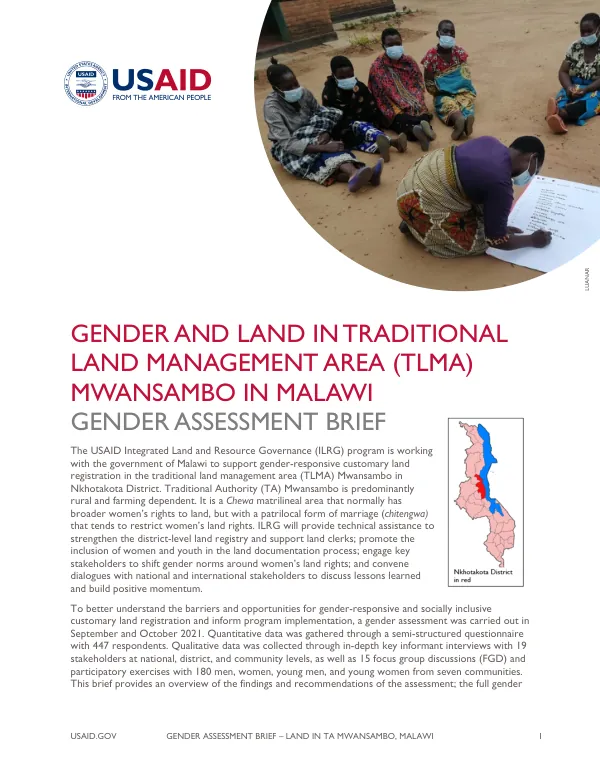
The traditional land management area (TLMA) Mwansambo in Nkhotakota District, Malawi, is predominantly rural and farming dependent.
2021 · 5 pages
Sign in to readA free account is required to download.
Abstract
It is a Chewa matrilineal area with broader women's rights to land, but a patrilocal form of marriage (chitengwa) tends to restrict women's land rights. The ILRG program is working with the government of Malawi to support gender-responsive customary land registration in Mwansambo. A gender assessment was carried out in September and October 2021 to better understand the barriers and opportunities for gender-responsive and socially inclusive customary land registration. Quantitative data was gathered through a semi-structured questionnaire with 447 respondents, while qualitative data was collected through in-depth key informant interviews with 19 stakeholders and 15 focus group discussions with 180 men, women, young men, and young women from seven communities. The assessment highlighted the existence of a strong normative framework that supports gender equality in land ownership in principle. However, some gaps remain, including the lack of specific provisions in the 2016 Customary Land Act to facilitate access to land for women, youth, and people with disabilities. Customary land governance is based on custom and practice, which leaves considerable potential for ambiguity that can be detrimental to women and other marginalized groups. Prevailing beliefs, attitudes, and social and gender norms in TA Mwansambo severely constrain women's rights to own and control land. Men are considered "heads of household" and responsible for economic activities, decision-making, and leadership in public spaces. Women are expected to be subservient and have limited physical and social mobility, impacting their ability to participate in community meetings and receive information. Men and especially women who attempt to break such norms are at risk of sanctions like social ostracism, ridicule, gossip, and physical violence. A gendered division of labor is present in the household, family farms, and beyond. Unpaid household and caring tasks are perceived as women's responsibilities, while men are involved in tasks that have monetary and social value. As such, men control income and how it is used. Women and girls hold a disproportionate share of household responsibilities, limiting their participation in other activities like community meetings and trainings. Women in TA Mwansambo have access to land, defined as the ability to use land. However, the chitengwa patrilocal marriage practice hinders women's ability to own and in some cases to access land. Although 88 percent of survey respondents agreed with the statement that women and men should have the same right to own land, prevailing gender norms hinder equal ownership in practice. Customary land is perceived to belong to the clan, and there is the perception that upon a woman's marriage or remarriage the family will lose such land if women move to another area and/or the family of their new spouses gain access and control over the original family's land. At the household level, men make most decisions related to land, including on purchase, sale, inheritance, renting, and using income. Women can influence some decisions, especially those related to household food production and consumption, but they cannot make decisions alone. This is especially true for decisions related to land, and the majority of women consulted believe they have no say in such decisions. The only time women are able to fully make decisions related to land is if they are divorced or single. When married women attempt to exercise greater agency on decision-making, it can lead to verbal, sexual, and physical violence. The assessment found that women are put in positions where they may have no or little influence in local governance committees, such as secretary. Structural barriers and gender biases ingrained in customary justice systems hamper redress mechanisms for women and other marginalized groups. The prevalence of GBV is high in Malawi, and although specific data for TA Mwansambo is not readily available, the assessment found that types of GBV like physical violence, economic abuse, sexual violence, and child marriage are the most prevalent in the area.