USAID DEC
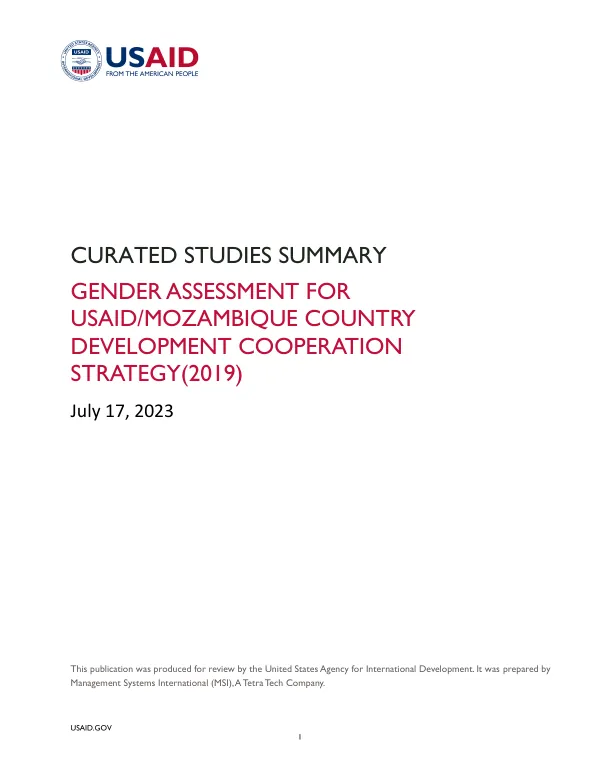
Gender Assessment for USAID/Mozambique Country Development Cooperation Strategy (2019)
Sign inMANAGEMENT SYSTEMS INTERNATIONAL
Gender Assessment for USAID/Mozambique Country Development Cooperation Strategy (2019)
The objective of this assessment was to inform the Mission's Country Development Cooperation Strategy (CDCS) for 2020-2025.
2023 · 6 pages
Sign in to readA free account is required to download.
Abstract
This assessment examined gender equality and female empowerment advances and challenges, and how USAID and others addressed them. The assessment concentrated on five key sectors: Education, Health, Economic Growth, Democracy and Governance, and Environment. Although this study was carried out in 2019, the information is still relevant for current and future activities. Improvements in enrollment, particularly at the primary level, have been observed. However, there are poor learning achievements as measured by low primary school completion rates, decreasing pass rates in exams, and lower scores on standardized tests. This suggests that girls may be going to school in greater numbers, but may not be advancing in terms of literacy or knowledge. Low school attendance among girls is attributed to various factors, including poverty, higher domestic workloads, lack of female role models, sexual abuse, and unintended pregnancy. The most common reasons for lower school attendance among girls include poverty, higher domestic workloads, lack of female role models, sexual abuse, and unintended pregnancy. Women in Mozambique are positioned below men in terms of rights, resources, and opportunities. Their gendered responsibilities as the primary caretakers for children and of the household translate into unpaid responsibilities, such as the collection of firewood or preparation of food for household members. The Mozambican labor market is characterized by a high degree of informality, with more than 90% of workers being self-employed or unremunerated as family workers. Outside the agricultural sector, women are most active in the sales and services sector. Democracy and governance represent an overarching challenge in Mozambique and a driving force for driving gender equality. Men hold positions of traditional power in Mozambican society, predominating as politicians, spiritual leaders, business leaders, and school heads. Mozambique ranks 17th in the world in terms of the representation of women in parliament (39.6%), but there is a large disparity in women's and men's representation in local institutions, authorities, and provincial assemblies. When asked, 70% of men and women state their migration is due to lack of food, drought conditions, or lack of water. Climate change forces families to migrate to areas where they are not at risk of flooding or droughts. Women leave behind their allotted land where they grow crops for sustenance and business, increasing their vulnerability. Most of the threats to conservation, which is focused on law enforcement and poaching, are male-driven, and most of the solutions are focused on them. Furthermore, women are generally left out of discussions related to the extractive industry, biodiversity efforts, and even ecotourism. Due to drought, women have had to spend more than six hours searching for and transporting water, increasing their exposure to violence and the likelihood that they will need to drop out of school to help.