USAID
Gender Digital Divide Risk Mitigation Technical Note
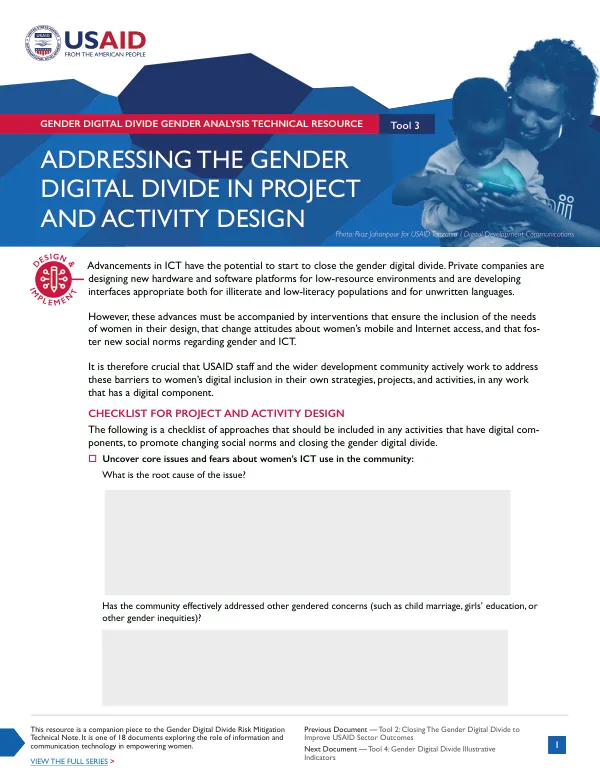
The digital divide between men and women in low- and middle-income populations is a significant issue, with women facing barriers to accessing and using information and communication technology (ICT).
2021 · 10 pages
Sign in to readA free account is required to download.
Abstract
This divide is reflected in the limited access and use of mobile phones and the Internet by women, particularly in rural areas and among lower-income groups. According to data from the International Telecommunication Union (ITU), the Internet penetration rate for women in developing countries is 40.7 percent, compared to 52.8 percent for men. This represents a significant gap, with 300 million fewer women than men in low- and middle-income countries using mobile Internet. The gap is even larger in certain regions, such as South Asia, where 207 million women do not own mobile phones, and sub-Saharan Africa, where 74 million women do not own mobile phones. The reasons for this digital divide are complex and multifaceted, but can be categorized into four broad areas: affordability, availability, ability, and agency. Affordability is a key driver of digital inclusion, and women are often less financially independent than men, with lower levels of income and less disposable income to spend on mobile or Internet services. This makes it cost-prohibitive for women to use digital ICT and services, particularly in low-resource communities. Availability is another significant barrier, with low levels of network quality and coverage creating additional barriers for women and girls. Women's choice of network is often restricted by various factors, including the cost of data and fewer choices of SIM. This is particularly problematic for women who live in poor and remote areas, where there are significant gaps in Internet coverage and adoption. Ability is also a critical factor, with women's use of mobile and Internet platforms often limited by their user capability and design. Women are less likely to have smartphones and more likely to have feature phones that do not support mobile Internet use. This is due in part to social norms and underlying gender inequalities, which restrict women's access to more advanced devices and limit their ability to use digital platforms effectively. Finally, agency is a critical factor, with women's ability to access and use digital ICT and services often limited by their social and cultural context. Women's roles, responsibilities, and time use are often shaped by societal expectations and norms, which can limit their ability to access and use digital technologies. In conclusion, the digital divide between men and women in low- and middle-income populations is a complex and multifaceted issue, driven by a range of factors including affordability, availability, ability, and agency. Addressing this divide will require a comprehensive approach that takes into account the social, cultural, and economic context in which women live and work. Research has shown that women's access to mobile phones and the Internet is often limited by their social and economic context. For example, a study by the GSMA found that women in rural areas are 32 percent less likely to use mobile Internet than women in urban areas. This highlights the need for targeted interventions that address the specific barriers faced by women in different contexts. In addition to addressing the barriers to access and use, it is also essential to promote the meaningful use of digital ICT and services by women. This includes providing training and support to help women develop the skills and confidence they need to use digital technologies effectively. It also involves promoting the use of digital platforms in ways that are relevant and beneficial to women's lives, such as through the use of mobile money and digital financial services. Ultimately, addressing the digital divide between men and women will require a sustained and comprehensive effort that takes into account the complex and multifaceted nature of this issue. By working together, we can help to ensure that women have equal access to the benefits of digital technologies and can participate fully in the digital economy.