USAID DEC
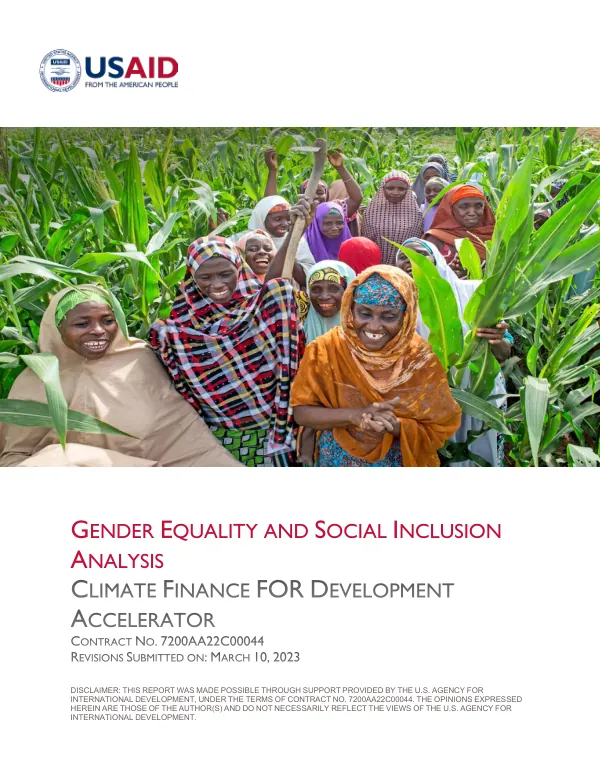
Gender Equality and Social Inclusion Analysis for the USAID Climate Finance for Development Accelerator
Sign inTHE INTERNATIONAL BANK FOR RECONSTRUCTION AND DEVELOPMENT
Gender Equality and Social Inclusion Analysis for the USAID Climate Finance for Development Accelerator
The Climate Finance for Development Accelerator (CFDA) is a global flagship climate finance activity that aims to mobilize private finance and private sector actions to support the transition to an equitable and resilient net-zero economy.
2024 · 22 pages
Sign in to readA free account is required to download.
Abstract
The Accelerator will serve as a platform for partnerships that draws on evidence to scale up finance for critical climate priorities. With a total budget of up to $250 million, the Accelerator aims to mobilize $2.5 billion of additional private and public finance for adaptation and mitigation by 2030. The Accelerator is organized around three objectives: Objective 1, which focuses on developing and scaling effective partnerships and solutions to achieve transformational change; Objective 2, which fosters an inclusive enabling environment to build shared vision and accelerate collective action; and Objective 3, which advances learning and development community capacity to mobilize catalytic private sector partnerships and finance. Across these objectives, the Accelerator offers a diverse set of services to advance near-term climate investments while applying systems thinking to strengthen locally led climate finance ecosystems required for sustained investments and a just transition to a net-zero, resilient economy. CFDA recognizes that the negative effects of climate change disproportionately affect women, youth, Indigenous Peoples, persons with disabilities, and other marginalized and underrepresented groups. The Accelerator appreciates the critical role these groups already play in developing and leading climate action to achieve collective goals. To ensure gender equality and social inclusion (GESI) become part of the DNA of all activities and programming, CFDA has developed a strategy to operationalize GESI across its activities and programming. The report is organized in two parts: Part I, which includes a GESI analysis of gender, youth, Indigenous Populations, and other underrepresented and marginalized groups, and Part II, which provides a programmatic approach to operationalizing GESI. The analysis takes an intersectional approach to inclusive climate finance, considering how gender intersects with other identities and how CFDA can achieve the most impact for women, girls, youth, Indigenous populations, and other underrepresented groups. The five-domain framework for gender analysis in USAID ADS 205 is used as a guiding framework to build and expand upon existing USAID gender analyses. This framework includes patterns of power and decision-making, laws, policies, regulations, and institutional practices that influence the context in which men and women act and make decisions; cultural norms and beliefs; gender roles, responsibilities, and time use; and access to and control over assets and resources. The domains are not exclusive, and their respective issues tend to overlap, thereby providing recurring themes that impact both explicit and implicit constraints on individuals. CFDA prioritizes GESI across the Climate Finance Ecosystem (CFE), considering both direct financing mechanisms and opportunities to strengthen the broader enabling environment to improve access to climate finance and opportunities to engage in climate action writ large. The Accelerator recognizes that incorporating GESI across programming will require a holistic systems approach that engages diverse stakeholders within the CFE.
Related documents