DAI GLOBAL, LLC
Gender Equality and Social Inclusion (GESI) Action Plan
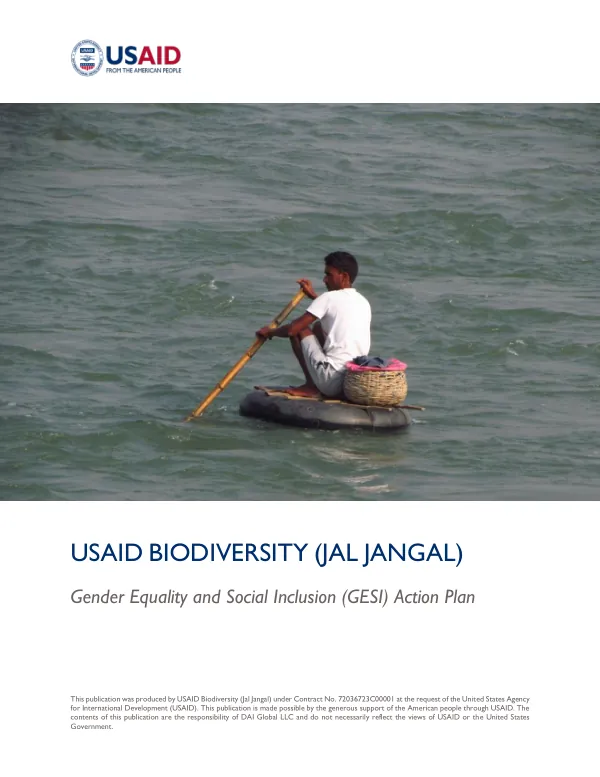
The Gender Equality and Social Inclusion (GESI) Action Plan is a comprehensive document developed by USAID Biodiversity (Jal Jangal) to promote gender equality and social inclusion throughout its implementation.
2023 · 17 pages
Sign in to readA free account is required to download.
Abstract
The plan prioritizes marginalized groups and youth, including the most marginalized caste/ethnic groups, indigenous communities, Muslims, women, persons with disabilities, and the lesbian, gay, bisexual, transgender, queer, intersex, asexual, plus (LGBTIQA+) community. The GESI Action Plan recognizes the impact of complex forms of marginalization and aims to address the identified GESI gaps in natural resource management (NRM), biodiversity conservation, and climate change. The plan is based on the key elements of USAID ADS 205 gender analysis framework and the ADS 201 Suggested Approaches for Inclusive Development. The GESI gaps identified through the GESI Analysis include laws, policies, regulations, and institutional practices that often lack clarity on the root causes of gender inequality and social exclusion. The plan recommends supporting clear and actionable integration of GESI in policies and training for conservation area offices, committees, and groups. Cultural norms, gender roles, responsibilities, and time use are also identified as a GESI gap, with harmful norms being hard to change when normalized and widely practiced. The plan recommends engaging with influential community-based stakeholders to transform harmful and discriminatory practices, including Gender-Based Violence (GBV). Access to and control over assets and resources is another GESI gap, with women and marginalized groups having limited formal education and skills training. The plan recommends providing capacity building and economic empowerment training for women and marginalized groups, as well as working with cooperatives to promote entrepreneurship and access to financial resources. The GESI Action Plan also identifies patterns of power and decision-making as a GESI gap, with training on the value of diversity, equity, inclusion, and accessibility in community decision-making recommended. Leadership training for women and marginalized groups and for those in the dominant group is also recommended. USAID Biodiversity (Jal Jangal) builds upon Nepal's achievements in the forestry and freshwater sectors, with its primary objective being biodiversity conservation, natural resource protection and management, and climate change adaptation. The activity will reduce multiple threats to the ecosystem and wildlife species to conserve nature, enhance human well-being, and safeguard the future. The development hypothesis of USAID Biodiversity (Jal Jangal) is illustrated in Figure 1, which shows that conservation of key habitats, ecosystems, and biodiversity will improve if the capacity to develop and implement environmental safeguards and address environmental crimes is enhanced, and if climate resilience of natural and human resources is strengthened. The GESI Action Plan will be implemented through activities aligned with three mutually interrelated and reinforcing objectives: improving the health of ecosystems, strengthening environmental crime control and natural resource safeguards, and enhancing the climate resilience of natural and human resources.
Related documents