DAI GLOBAL, LLC
Theories of Change and Results Chains
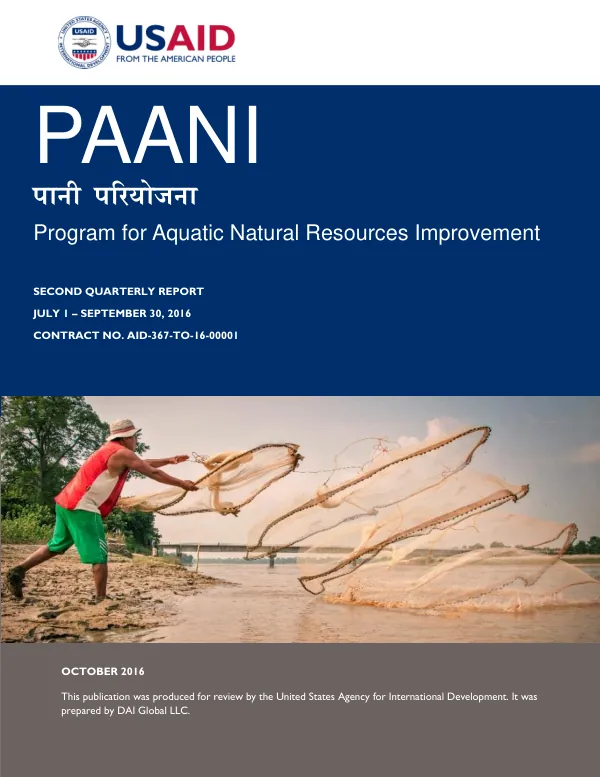
The Paani Program is a 5-year, $25 million USAID-funded project in Nepal, awarded on April 11, 2016.
2018 · 25 pages
Sign in to readA free account is required to download.
Abstract
The program aims to enhance Nepal's ability to manage water resources through climate change adaptation and the conservation of freshwater biodiversity. The program focuses on the Karnali, Mahakali, and Rapti river basins and has approximately $5 million in grants and activity procurements. The program objectives are to reduce threats to freshwater biodiversity, increase the ability of targeted human and ecological communities to adapt to climate change, and improve water management. To achieve these objectives, the program will implement 11 strategic approaches and four intermediate results, as defined in the Paani Contract, Annual Work Plans, and a Monitoring and Evaluation Plan. The Paani Program recognizes the importance of mainstreaming Gender Equality and Social Inclusion (GESI) concerns and approaches to improve project impact, performance, and sustainability. The program aims to increase knowledge, engagement, and benefits for local water users, improve basin-level resource management, strengthen coordination, and create an enabling environment to develop effective policies and programs. The GESI Mainstreaming Guidelines were developed to assist project implementing staff and partner organizations to effectively and adequately mainstream GESI concerns and approaches in all stages of the project cycle. The guidelines contain a list of questions and associated actions that need to be considered at two levels: the Paani Program and by implementing partners in the field. The guidelines also include a set of worksheets that are easy and practical for those who are implementing the project in the field level. It is recommended that the GESI Specialist field test the guidelines and the accompanying worksheets prior to finalizing them for use by project implementing staff and partners. The Paani Program's objectives are aligned with the national framework contained in the Constitution of Nepal (2015), which envisions Nepal as an inclusive state and guarantees the right to equality for all its citizens. The program's focus on mainstreaming GESI is also consistent with the Government of Nepal's Approach Paper for the 14th three-year plan, which aims to achieve economic prosperity with social justice. The GESI guidelines are designed to assist project implementing staff and partner organizations to effectively and adequately mainstream GESI concerns and approaches in all stages of the project cycle. The guidelines provide definitions of key terms, including GENDER, GENDER EQUALITY AND SOCIAL INCLUSION (GESI), and SOCIAL INCLUSION. The Paani Program's approach to GESI is based on the concept that addressing unequal power relations between women and men and between different social groups is essential to achieving the program's objectives. The program recognizes that climate change and biodiversity impacts exacerbate gender inequalities and social exclusion, and that mainstreaming GESI is critical to improving project impact, performance, and sustainability. The program's GESI guidelines are designed to be practical and easy to use, and are intended to support project implementing staff and partner organizations in mainstreaming GESI concerns and approaches in all stages of the project cycle. The guidelines are an important tool for the Paani Program in achieving its objectives and contributing to the sustainable management of water resources in Nepal.
Related documents