USAID DEC
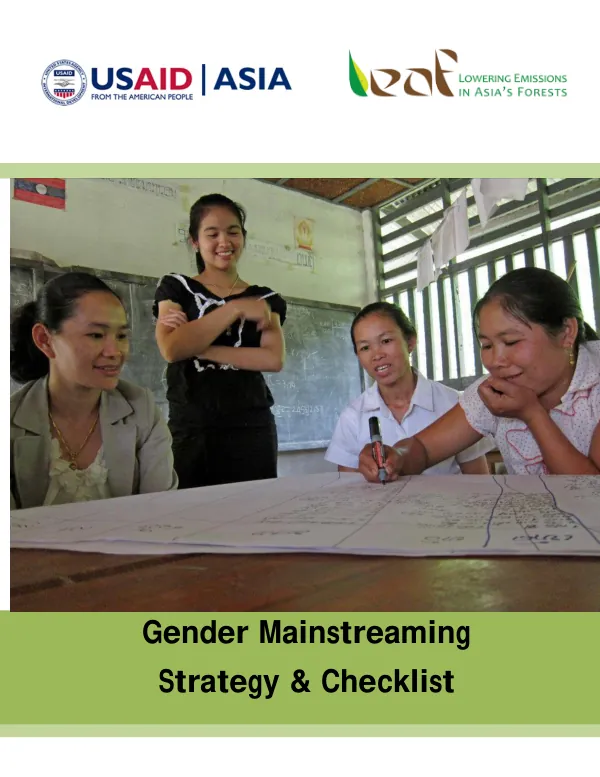
Gender Mainstreaming Strategy & Checklist for Lowering Emissions in Asia’s Forests (LEAF) Program
Sign inUSAID
Gender Mainstreaming Strategy & Checklist for Lowering Emissions in Asia’s Forests (LEAF) Program
Climate change mitigation is a highly technical and rapidly evolving subject that offers significant promise to produce multiple mitigation and sustainable development benefits to both women and men.
2012 · 18 pages
Sign in to readA free account is required to download.
Abstract
However, the delivery of this anticipated promise depends greatly upon how climate change mitigation projects are implemented in practice and to what extent they offer solutions to legitimate stakeholders. Women and men, owning to their gendered responsibilities, possess unique knowledge-sets about forest resources that can be applied to achieving successful sustainable forest management. The Lowering Emissions in Asia's Forests (LEAF) Program, a five-year cooperative agreement, is funded by the United States Agency for International Development's (USAID) Regional Development Mission for Asia (RDMA). LEAF is being implemented by Winrock International (Winrock), in partnership with SNV – Netherlands Development Organization, Climate Focus, and The Center for People and Forests (RECOFTC). The LEAF program began in 2011 and will continue until 2016. The program aims to strengthen the capacities of developing countries in Asia to produce meaningful and sustainable reductions in greenhouse gas (GHG) emissions from the forest-land use sector. Climate change mitigation has a significant gender dimension, particularly in the context of REDD+ (Reducing Emissions from Deforestation and Forest Degradation). Women and men are responsible for collecting and managing different forest resources in distinct and different ways. Rural women are primary users of forest resources for food, fodder, fuelwood, medicine, and other non-timber forest products to meet their family's daily needs. Women play an important role in minor extraction for energy use, household consumption, and supplemental income. Because of their gendered responsibilities, they possess unique knowledge sets about forest resources that can be applied to achieving successful sustainable forest management. Gender equality is a pre-condition for climate change mitigation effectiveness. It means that women and men have the same opportunities and rights to all aspects of human development. Existing evidence indicates that women have not been systematically identified as stakeholders in REDD+, PES (Payment for Ecosystem Services), land use planning, and sustainable forest management initiatives. Consequently, they have not been involved in related policy discussions and pilot demonstration activities. Gender issues have not been specifically identified by key actors as having any relevance to the climate change mitigation sector. LEAF's approach to gender mainstreaming involves a systematic examination of the similarities and differences in the conditions and positions of women/girls and men/boys. This process calls for identifying appropriate interventions and approaches to ensure that LEAF reduces existing gender gaps, does not promote new gaps, and benefits both women and men. The LEAF program aims to provide a framework for implementing its commitment to gender-inclusive climate change mitigation and to identify the required inputs.