PACT
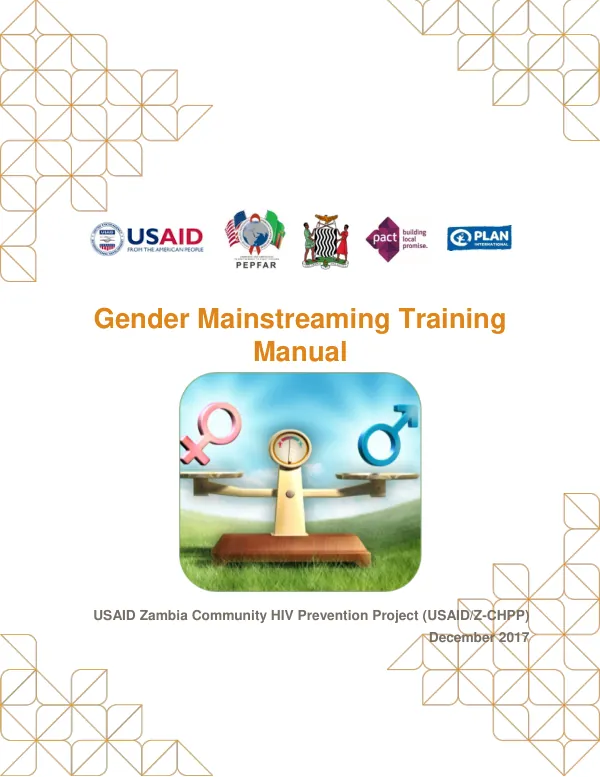
Gender Mainstreaming Training Manual, USAID/Z-CHPP
The USAID Zambia Community HIV Prevention Project (USAID/Z-CHPP) is a five-year cooperative agreement led by Pact to accelerate progress toward Zambia's goal of reducing new human immunodeficiency virus (HIV) infections.
2017 · 71 pages
Sign in to readA free account is required to download.
Abstract
The project supports Zambia to reach the United Nations Program on HIV (UNAIDS) 2020 goal of having 90% of all people living with HIV (PLHIV) know their status, 90% of those who know their HIV-positive status receiving sustained anti-retroviral therapy (ART), and 90% of those on ART achieving viral suppression. To accomplish its goal, USAID/Z-CHPP will increase the adoption of high-impact HIV services and protective behaviors among at-risk populations using evidence-based and locally owned solutions. The project has four specific objectives: mitigating key determinants of risky behavior among priority populations, increasing completed referrals from community programs to high-impact services, reducing young women's vulnerability to HIV, unintended pregnancy, and sexual and gender-based violence (SGBV), and strengthening the capacity of local stakeholders to plan, monitor, evaluate, and ensure the quality of prevention interventions. USAID/Z-CHPP maximizes the impact of USAID resources by focusing on high-prevalence districts, targeting populations at high risk of infection or infecting others, and tailoring approaches to different segments of the population. Activities are implemented directly by Pact and its core international partner, Plan International USA, as well as by local partners through sub-grants. This approach leverages existing relationships at the community level by engaging and supporting traditional and religious leaders, community-based service providers, and the decentralized government structures. The project implements activities in 25 priority districts across Lusaka, Central, Copperbelt, Western, North Western, and Southern provinces. Within each district, USAID/Z-CHPP aims to achieve a high saturation of interventions, focusing first on rapid scale-up of HIV testing services (HTS) and reaching PLHIV who are outside of the treatment cascade, then expanding the coverage and scope of activities with a comprehensive package of interventions to reach priority high-risk populations, including adolescent girls and boys, young women and men, PLHIV, serodiscordant couples, and other priority populations. The gender mainstreaming training manual is a resource for facilitating a workshop for USAID/Z-CHPP partners and their project cadres working at the community level. The training manual serves as a guide for facilitating a gender mainstreaming workshop, which aims to equip participants with the knowledge and skills necessary to integrate gender perspectives into their work. The manual is divided into seven modules, each focusing on a different aspect of gender mainstreaming, including gender terminology and concepts, the social construction of gender, gender and HIV linkages, and action planning and commitments. The training manual is designed to be flexible and adaptable to the needs of different participants and contexts. It includes trainer tips and handouts to support facilitators in delivering the training, as well as examples and case studies to illustrate key concepts and principles. The manual is intended to be used in conjunction with other training materials and resources to provide a comprehensive training package for USAID/Z-CHPP partners and their project cadres. The project's focus on gender mainstreaming is critical to achieving its objectives and reducing the vulnerability of young women to HIV, unintended pregnancy, and SGBV. By integrating gender perspectives into its work, USAID/Z-CHPP aims to promote more effective and sustainable HIV prevention interventions that address the needs and concerns of all stakeholders, particularly women and girls.
Related documents