GLOBAL CENTER FOR FOOD SYSTEMS INNOVATION
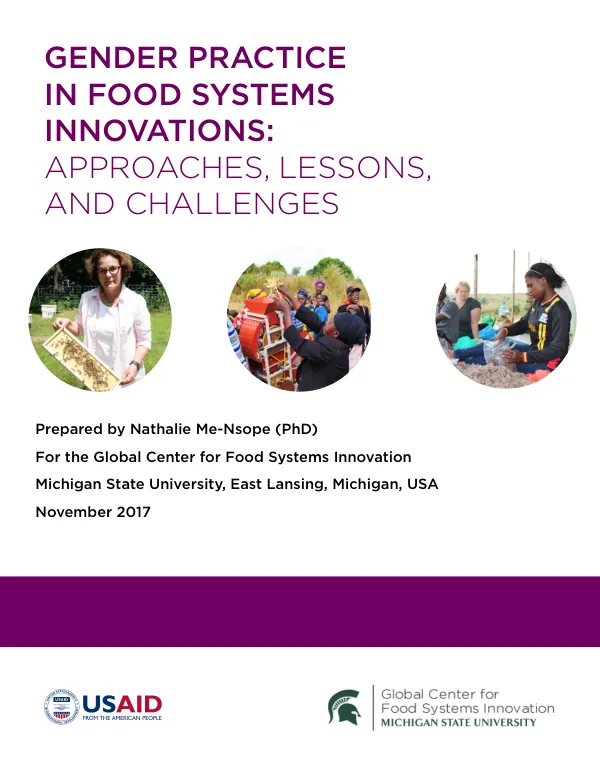
Gender Practice in Food Systems Innovations: Approaches, Lessons, and Challenges
The concept of gender practice in food systems innovations is a critical aspect of addressing specific challenges in the food systems.
2017 · 38 pages
Sign in to readA free account is required to download.
Abstract
Innovations in the food systems refer to new ideas, new knowledge, and technologies for addressing specific food system challenges. These innovations are often triggered by a challenge and are designed to improve or make better from a previous state, condition, approach, or result. Food systems include the interactions between and within the biophysical and human environment, which determines a set of activities related to the production, processing, and packaging of food, distribution and retailing of food, preparation and consumption of food, and the outcomes of which contribute to food security, environmental security, and social welfare. Food systems are embedded in environments that differ according to a variety of factors such as agro-ecology, climate, social aspects, economics, health, and policy. Gender is a social construct that refers to relations between and among the sexes, based on their relative roles in a specific social context. It encompasses the economic, political, and sociocultural attributes, constraints, and opportunities associated with being male or female. The social definitions of what it means to be male or female vary among cultures and change over time. Gender is relational and refers not simply to women or men but to the relationship between them. Gender roles are the role or behavior learned by a person as appropriate to their gender, determined by the prevailing cultural norms. A set of societal norms dictating the types of behaviors which are generally considered acceptable, appropriate, or desirable for people based on their actual or perceived sex or sexuality. These roles are assigned by social criteria rather than biological. Gender relations emphasize the relationship between men and women as demonstrated by their respective roles in power sharing, decision making, the division of labor, returns to labor, both within the household and in the society at large. The gender division of labor is an overall societal pattern where women are allotted one set of gender roles and men are allotted another set. An unequal gender division of labor refers to situations in which there is an unequal division of the rewards of labor by sex, i.e., discrimination. The most obvious pattern in the gender division of labor is that women are mostly confined to unpaid domestic work and unpaid food production, whereas men dominate in cash crop production and wage employment. Gender-based constraints refer to restrictions on men's or women's access to resources or opportunities that are based on their roles or responsibilities. These constraints encompass the measurable inequalities identified by sex-disaggregated data and gender analysis and the factors that contribute to a specific condition of gender inequality. Gender analysis is a systematic social science tool used to identify, understand, and explain gaps between males and females that exist in households, communities, and countries. It is also used to identify the relevance of gender norms and power relations in a specific context. Gender analysis typically involves examining differences in the status of women and men and their differential access to assets, resources, opportunities, and services, as well as the influence of gender roles and norms on the division of time between paid employment, unpaid work, and volunteer activities. Gender integration refers to strategies for making women's as well as men's concerns and experiences an integral dimension in the design, implementation, monitoring, and evaluation of policies and programs in all political, economic, and social spheres. Gender integration involves identifying and addressing gender inequalities during strategy and project design, implementation, and monitoring and evaluation. Since the roles and power relations between men and women affect how an activity is implemented, it is essential that project managers address these issues on an ongoing basis. The importance of conducting a gender analysis prior to project design cannot be overstated. It is a critical step in creating gendered food systems innovations that improve/enhance the processes and outcomes of food systems innovations. Gender analysis makes clear how gender roles and relations create opportunities or obstacles for achieving development objectives. It is a very important step in creating gendered food systems innovations that add value to research and increase the likelihood that food systems innovations will achieve their overall goals of reducing poverty, promoting nutrition and food security, and sustainability.
Related documents