JBS INTERNATIONAL, INC.
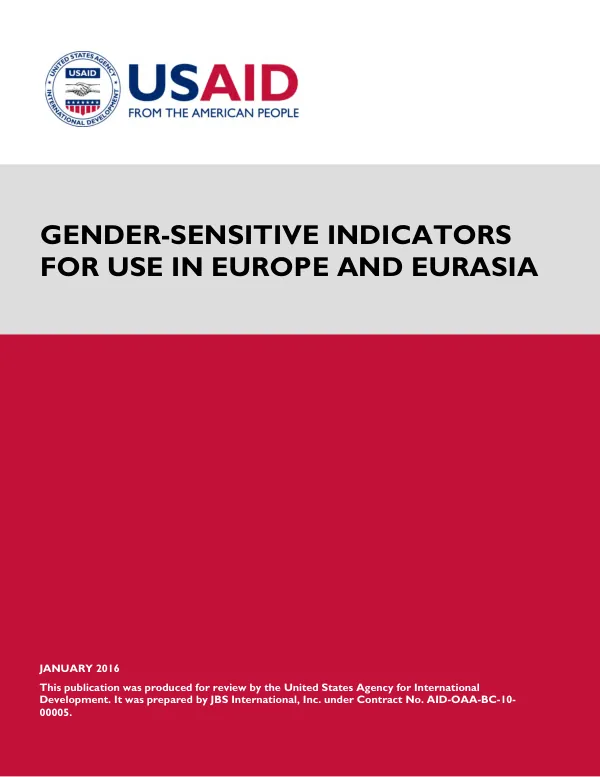
Gender-Sensitive Indicators for Use in Europe and Eurasia
The Gender-Sensitive Indicators for Use in Europe and Eurasia document is a toolkit designed to support the measurement of gender-sensitive outcomes in development programs.
2016 · 158 pages
Sign in to readA free account is required to download.
Abstract
The toolkit is organized into four sections, each focusing on a different aspect of gender-sensitive measurement. Section 1, Introduction, provides an overview of the toolkit's purpose and structure. The toolkit is intended to support USAID's commitment to gender equality and rigorous measurement. It outlines the methodology used to develop the toolkit and provides an overview of the sections that follow. Section 2, USAID and Gender-Sensitive Measurement, discusses USAID's commitment to gender equality and the requirements for gender-sensitive measurement. The section highlights the importance of measuring gender-sensitive outcomes and provides an overview of the tools and resources available to support this effort. Section 3, Adopting Gender-Sensitive Measurement, provides guidance on understanding and applying gender-sensitive indicators (GSIs). The section defines what a GSI is and explains how it can be used in conjunction with the logic model (LM) to measure gender-sensitive outcomes. It also provides resources for further learning and application. Section 4, Notes on Gender-Sensitive Indicators in 15 E&E Project Areas, provides guidance on the use of GSIs in specific project areas, including agriculture, energy and environment, elections and political party processes, and others. Each guidance note provides an overview of the gender issues and gaps in the specific project area, followed by a discussion of the GSIs that can be used to measure gender-sensitive outcomes. The toolkit includes four guidance notes, each focusing on a different project area. Guidance Note 1, Gender-Sensitive Indicators for the Agriculture Sector, provides an overview of the gender issues and gaps in the agriculture sector and discusses the GSIs that can be used to measure gender-sensitive outcomes. Guidance Note 2, Gender-Sensitive Indicators for the Energy and Environment Sectors, provides an overview of the gender issues and gaps in the energy and environment sectors and discusses the GSIs that can be used to measure gender-sensitive outcomes. Guidance Note 3, Gender-Sensitive Indicators for Elections and Political Party Processes, provides an overview of the gender issues and gaps in elections and political party processes and discusses the GSIs that can be used to measure gender-sensitive outcomes. Guidance Note 4, Gender-Sensitive Indicators for the Education Sector, provides an overview of the gender issues and gaps in the education sector and discusses the GSIs that can be used to measure gender-sensitive outcomes. The toolkit also includes a list of acronyms and abbreviations, acknowledgments, and references for further learning and application. Overall, the Gender-Sensitive Indicators for Use in Europe and Eurasia document is a comprehensive toolkit designed to support the measurement of gender-sensitive outcomes in development programs. It provides guidance on understanding and applying GSIs and includes resources for further learning and application.
Related documents