USAID
AVALIAÇÃO DE GÊNERO NAS ÁREAS DA NOVO MADAL
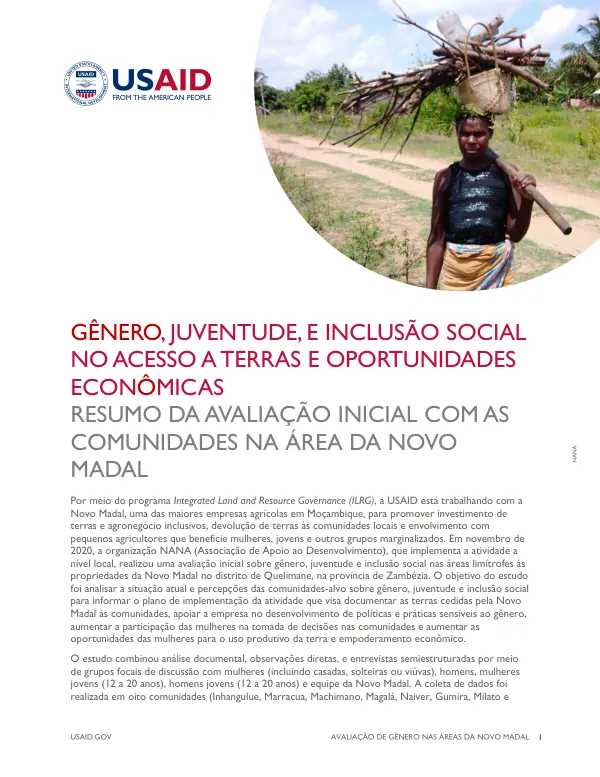
In Mozambique, the USAID is working with the Novo Madal, a major agricultural company, to promote inclusive land and agricultural investment, land return to local communities, and involvement with small farmers that benefits women, youth, and other marginalized groups.
2021 · 8 pages
Sign in to readA free account is required to download.
Abstract
The organization NANA (Associação de Apoio ao Desenvolvimento), which implements the activity at the local level, conducted an initial assessment on gender, youth, and social inclusion in the areas adjacent to Novo Madal's properties in the district of Quelimane, Zambézia province, in November 2020. The study aimed to analyze the current situation and perceptions of the target communities on gender, youth, and social inclusion to inform the implementation plan of the activity, which aims to document the lands ceded by Novo Madal to the communities, support the company in developing gender-sensitive policies and practices, increase women's participation in decision-making in the communities, and increase women's opportunities for productive land use and economic empowerment. The study combined documentary analysis, direct observations, and semi-structured interviews through focus group discussions with women (including married, single, or widowed women), men, young women (12-20 years old), young men (12-20 years old), and Novo Madal staff. Data collection was conducted in eight communities (Inhangulue, Marracua, Machimano, Magalá, Naiver, Gumira, Milato, and Mussuloga) on Novo Madal's properties in Temane and Malacuari, accounting for 60% of the target communities. The main findings of the analysis on gender, youth, and social inclusion are as follows: Participation in income-generating activities is predominantly led by men, with women and young people playing a secondary role. The majority of families (84%) rely on agriculture as their primary source of income, followed by small businesses (11%) and employment (5%). Women are responsible for managing the household and caring for children, while men are responsible for managing the land and generating income. The study also found that the division of labor is deeply ingrained in the communities, with women and men having distinct roles and responsibilities. Women are responsible for domestic chores, such as cooking, fetching water, and collecting firewood, while men are responsible for outdoor activities, such as farming and hunting. The study highlights the need to address the gender disparities in the communities and to promote greater participation of women and young people in decision-making and income-generating activities. The study's findings have significant implications for the implementation of the activity, which aims to promote inclusive land and agricultural investment, land return to local communities, and involvement with small farmers that benefits women, youth, and other marginalized groups. The study's recommendations include the need to develop gender-sensitive policies and practices, increase women's participation in decision-making, and promote greater participation of women and young people in income-generating activities.