USAID DEC
Generating Electricity from Biogas from Palm Oil Mill Effluent | Global Climate Change
Sign inICF
Generating Electricity from Biogas from Palm Oil Mill Effluent | Global Climate Change
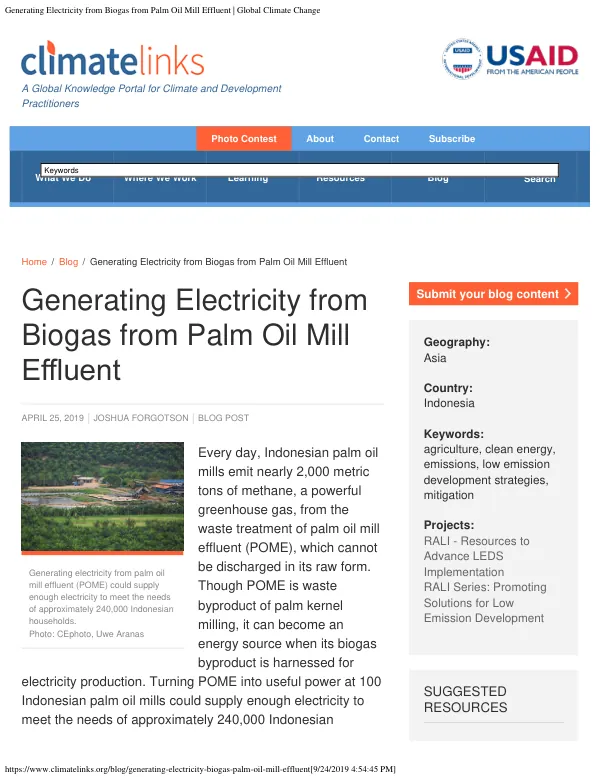
Generating electricity from biogas produced from palm oil mill effluent (POME) has the potential to supply enough electricity to meet the needs of approximately 240,000 Indonesian households.
2019 · 4 pages
Sign in to readA free account is required to download.
Abstract
This is based on the recovery of biogas from POME to produce electricity and reduce greenhouse gas emissions, a practice that has been widely adopted across Southeast Asia. The recovery of biogas from POME involves the capture and utilization of methane, a potent greenhouse gas, which is emitted from the waste treatment of palm oil mill effluent. By harnessing this biogas, it is possible to generate electricity and reduce greenhouse gas emissions. In Indonesia, implementing POME-to-biogas renewable energy projects at 100 of the country's 742 mills could supply enough electricity to meet the needs of approximately 240,000 households and reduce greenhouse gas emissions by 2.6 million metric tons of CO2 equivalent per year. Lessons learned from efforts undertaken at three Indonesian palm oil mills, supported by the Millennium Challenge Account-Indonesia and the Millennium Challenge Corporation, demonstrate the substantial greenhouse gas emission reductions and financial benefits of generating electricity from biogas from POME. The projects, implemented by Musim Mas, a leading palm oil producer, have shown that this practice is an effective means of supporting low emission development. Implementing POME-to-biogas renewable energy projects at additional mills in Indonesia could increase households' access to renewable energy, reduce the environmental impact of the palm oil industry, and increase its economic competitiveness. In neighboring countries such as Thailand and Malaysia, there is clear evidence of successful widespread adoption of POME capture and utilization for renewable energy generation. Indonesia could benefit from accelerating this trend, which could help address energy access and reduce its overall greenhouse gas emissions. The benefits of scaling up POME-to-biogas renewable energy projects in Indonesia include the potential to supply enough electricity to meet the needs of approximately 240,000 households and reduce greenhouse gas emissions by 2.6 million metric tons of CO2 equivalent per year. To encourage the success of these efforts, several recommendations have been made, including the use of proven technology and standard design for multiple projects, early engagement with the electric utility, and consideration of community benefit-sharing plans to share potential revenues with local communities.
Related documents