USAID DEC
Generating Spaces for Peaceful Coexistance, Reconciliation, and Economic Improvement in Youth in Ciénaga’s Fishing Region
Sign inUSAID
Generating Spaces for Peaceful Coexistance, Reconciliation, and Economic Improvement in Youth in Ciénaga’s Fishing Region
The Generating Spaces of Peaceful Coexistence project in Ciénaga's fishing region aims to promote economic improvement and reconciliation among youth.
2019 · 4 pages
Sign in to readA free account is required to download.
Abstract
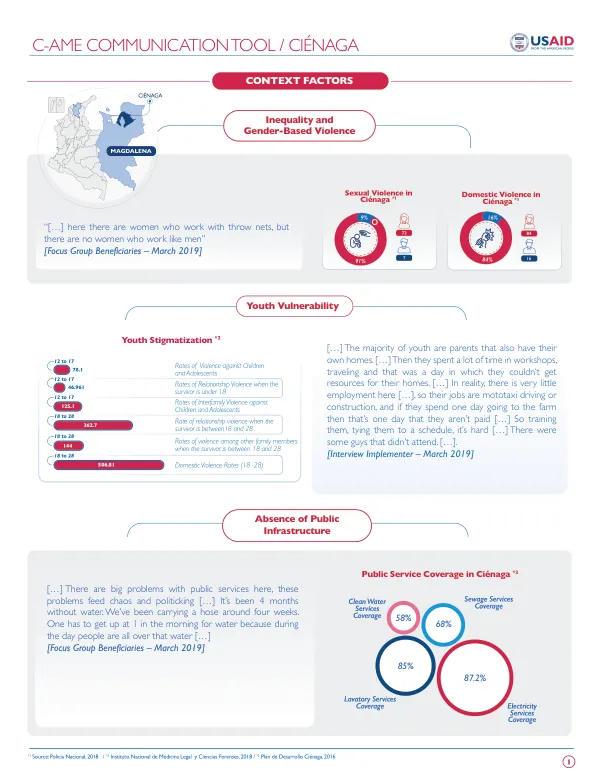
The project is funded by USAID, with 58% of the funding coming from USAID and 42% from other sources. The project's main objective is to empower beneficiaries, particularly women, to participate in productive activities and challenge traditional gender roles. Inequality and gender-based violence are significant context factors in the region. Focus group beneficiaries reported that women are often excluded from fishing activities due to societal expectations and lack of trust in institutions. The beneficiaries also expressed frustration with the lack of public services, including access to clean water, sanitation, and electricity. In Nueva Venecia, a nearby town, the situation is even more dire, with a lack of governance and a history of paramilitary violence. The project has observed advances in empowering beneficiaries, but also faces challenges related to the implementation of the outboard motors business (SOLUTEAM). C-AME recommends verifying the status of the implementation, assessing execution times, and creating space for dialogue between the implementing partner and youth to address their frustration with delays. Additionally, C-AME suggests designing short and medium-term incentives to alleviate the youth's lack of income and improve their ability to participate. To deconstruct traditional gender roles, C-AME recommends fostering an exchange of experiences among participants to discuss the roles and trades assigned to male and female beneficiaries. This space could also address the insertion of women in productive areas historically occupied by men, the labor effects of structural inequality, and the lack of workspaces for LGBTI people. Furthermore, C-AME recommends expanding the Gender and Social Inclusion Strategy to the beneficiary's family group, carrying out workshops with beneficiaries' spouses to advance in the construction of more democratic and egalitarian gender relations. The project also faces challenges related to the Ecotourism Promotion project in Sitionuevo, including the need to provide livelihood opportunities for the community and ensure ecological sustainability. C-AME recommends creating and strengthening trust between community members by taking into account the trust-building tools employed before and during the conflict, as well as strategies for addressing the past and restoring trust. The C-AME team further recommends linking the program with the process of reconstructing the social fabric undertaken by the Unit for Attention and Integral Reparation to Victims (UARIV).