TETRA TECH
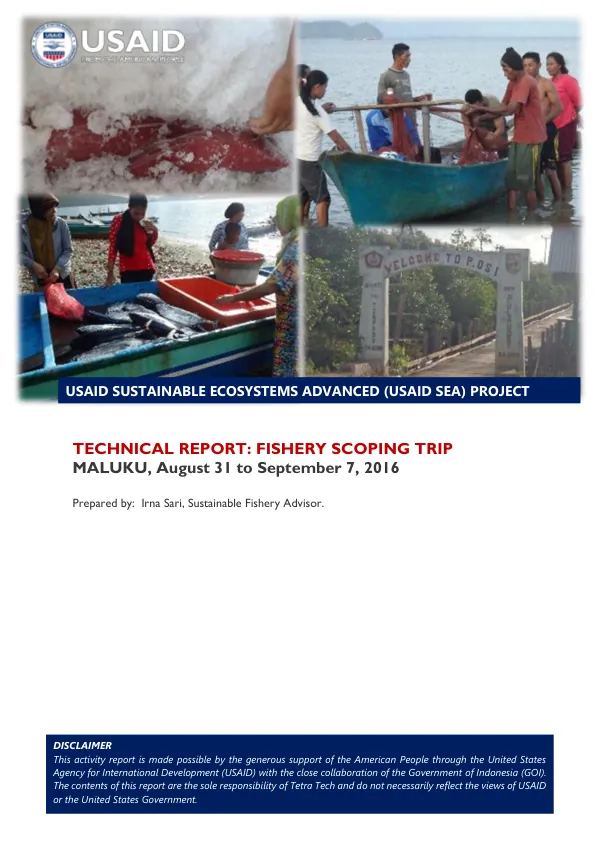
Technical Report: Fisheries Scoping Trip, Maluku
The fisheries sector plays a significant role in the social and economic development of Maluku Province.
2016 · 26 pages
Sign in to readA free account is required to download.
Abstract
The sector contributes 23.79% to the total Maluku Province Gross Domestic Regional Product, making it the largest contributor among other sectors. The fisheries sector also provides employment opportunities for a significant number of people, with 16% of the population engaged in fishing activities, both as full-time and part-time fishers. This figure reflects the importance of the fisheries sector for local livelihoods. The Maluku Province reported 15 primary commodities in 2015, with skipjack being the largest volume of species caught, accounting for 10.55% of the total harvest. Small-pelagic fisheries is also an important fishery, covering various species. Demersal fishery, specifically red-snapper, is included within the 15 primary commodities landed in Maluku Province. The fisheries sector provides income opportunities for women, and the benefits of the sector extend beyond fishing activities to include spill-over activities along the capture fishery supply chains, such as collecting, processing, and trading. The sector is also a significant contributor to the local economy, with the fisheries sector, agricultural sector, and forestry sector together contributing 23.79% to the total Maluku Province Gross Domestic Regional Product. The districts of West Seram, East Seram, and part of Central Seram Districts fall under the 715 FMA in the Maluku Province. These districts are home to 95,551 fishers involved as full-timers and part-timers. The vast majority of them are fishers with less than 10GT fishing vessels. The fisheries sector in Maluku Province has a significant socio-economic impact, providing employment opportunities and contributing to the local economy. The sector's importance is reflected in the large number of people engaged in fishing activities and the significant contribution to the local economy. The fisheries sector in Maluku Province is characterized by a diverse range of species, with skipjack being the largest volume of species caught. The sector provides income opportunities for women and extends beyond fishing activities to include spill-over activities along the capture fishery supply chains. The sector's importance is reflected in the significant contribution to the local economy and the large number of people engaged in fishing activities. The fisheries sector in Maluku Province has a significant role in the social and economic development of the region. The sector contributes to the local economy, provides employment opportunities, and extends beyond fishing activities to include spill-over activities along the capture fishery supply chains. The sector's importance is reflected in the large number of people engaged in fishing activities and the significant contribution to the local economy.