USAID DEC
RAPD fingerprinting key and phylogenetic of nine seagrass species from Sanur coastal water, Bali, Indonesia using matK sequences
Sign inUSAID DEC
RAPD fingerprinting key and phylogenetic of nine seagrass species from Sanur coastal water, Bali, Indonesia using matK sequences
Seagrasses are flowering plants that grow in shallow water of coastal regions.
2016 · 7 pages
Sign in to readA free account is required to download.
Abstract
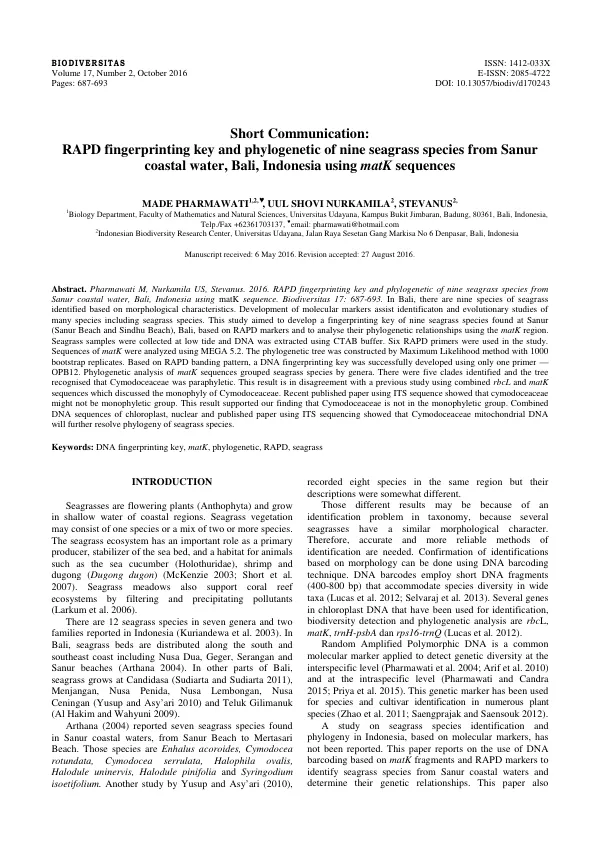
They may consist of one species or a mix of two or more species. The seagrass ecosystem has an important role as a primary producer, stabilizer of the sea bed, and a habitat for animals such as the sea cucumber, shrimp, and dugong. Seagrass meadows also support coral reef ecosystems by filtering and precipitating pollutants. In Bali, there are nine species of seagrass identified based on morphological characteristics. These species are Enhalus acoroides, Cymodocea rotundata, Cymodocea serrulata, Halophila ovalis, Halodule uninervis, Halodule pinifolia, Syringodium isoetifolium, Thalassia hemprichii, and Thalassia ciliata. However, previous studies have reported different results, which may be due to an identification problem in taxonomy. Several seagrasses have similar morphological characters, making accurate identification challenging. To address this issue, a study was conducted to develop a DNA fingerprinting key for seagrass species based on RAPD markers and to analyze their phylogenetic relationships using the matK region. Seagrass samples were collected from Sanur Beach and Sindhu Beach, Bali, and DNA was extracted using CTAB buffer. Six RAPD primers were used in the study, and sequences of matK were analyzed using MEGA 5.2. The phylogenetic tree was constructed by Maximum Likelihood method with 1000 bootstrap replicates. Based on RAPD banding pattern, a DNA fingerprinting key was successfully developed using only one primer, OPB12. Phylogenetic analysis of matK sequences grouped seagrass species by genera. There were five clades identified, and the tree recognized that Cymodoceaceae was paraphyletic. This result is in disagreement with a previous study using combined rbcL and matK sequences, which discussed the monophyly of Cymodoceaceae. The study also supported the finding that Cymodoceaceae is not a monophyletic group. The development of a DNA fingerprinting key for seagrass species based on RAPD markers is a significant contribution to the field of seagrass research. This key can be used to accurately identify seagrass species, which is essential for conservation and management efforts. The study also highlights the importance of using molecular markers to analyze phylogenetic relationships among seagrass species. The results of this study can be used to inform future research on seagrass ecology and conservation.