USAID
Getting Employment to Work: A Playbook for the Field
The employment development initiative in a given country begins with a diagnosis of the current economic growth and employment challenges.
2019 · 10 pages
Sign in to readA free account is required to download.
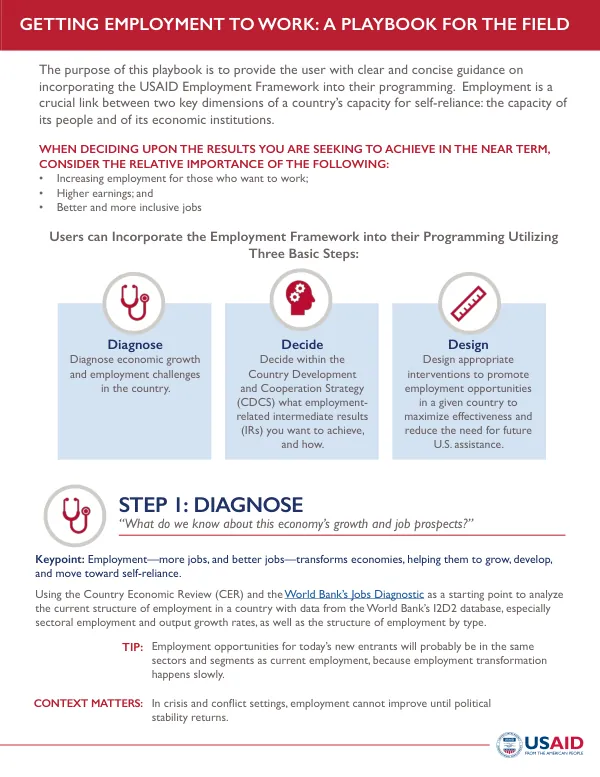
Abstract
This involves analyzing the country's economic structure, including sectoral employment and output growth rates, as well as the structure of employment by type. The World Bank's Jobs Diagnostic and the Country Economic Review (CER) serve as starting points for this analysis, utilizing data from the World Bank's I2D2 database. Employment opportunities for new entrants are likely to be in the same sectors and segments as current employment, as employment transformation occurs slowly. In crisis and conflict settings, employment cannot improve until political stability returns. The diagnosis phase aims to establish a clear picture of employment challenges and opportunities, even if some are outside of USAID's current comparative advantage to address. There are three main categories of jobs in USAID host countries: wage or salary jobs, self-employment on a family farm, and self-employment in a household business (microenterprise). Modern, private sector firms tend to produce the most formal, highest-paying jobs, making it the most effective strategy for increasing overall employment to focus on growing employment in this sector. Providing the right skills and information to youth, women, or disadvantaged groups is also essential for making employment more inclusive and productive. The USAID Employment Framework provides a three-step approach to incorporating employment into programming: diagnose, decide, and design. The diagnose phase involves analyzing the current economic growth and employment challenges in the country. The decide phase focuses on determining the employment-related intermediate results to be achieved within the Country Development and Cooperation Strategy (CDCS). The design phase involves designing appropriate interventions to promote employment opportunities in a given country to maximize effectiveness and reduce the need for future U.S. assistance. Key points for designing effective interventions include the entry and growth of modern firms, increasing labor productivity, access to information, capital, skills, and a location to work. Skills improve employment prospects, even though they do not generate jobs directly or guarantee an increase in earnings. To determine the most effective interventions, consider the following questions: is labor demand weak, and if so, focus on increasing employment and earnings overall; or is labor demand strong, and if so, focus on achieving better or more inclusive jobs. The USAID Employment Framework provides evidence-based recommendations for increasing labor demand, including the entry and growth of modern firms. Key recommendations include facilitating the removal of systemic policy barriers to productivity, competition, trade, foreign direct investment, and infrastructure. Other recommendations include increasing access to finance, improving market access, supporting product innovation, and building management practices in existing firms.