ELIZABETH GLASER PEDIATRIC AIDS FOUNDATION
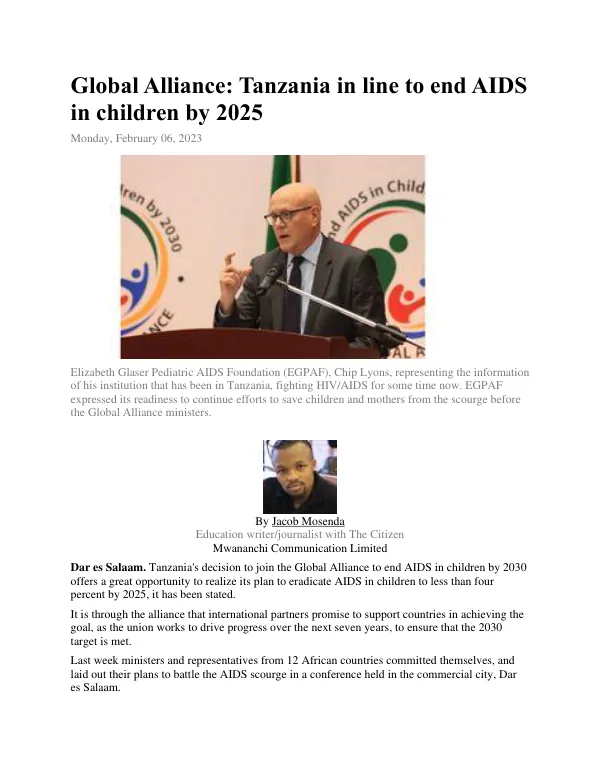
Global Alliance: Tanzania in line to end AIDS in children by 2025
Tanzania's decision to join the Global Alliance to end AIDS in children by 2030 offers a great opportunity to realize its plan to eradicate AIDS in children to less than four percent by 2025.
2023 · 3 pages
Sign in to readA free account is required to download.
Abstract
The alliance aims to work over the next seven years to ensure that the 2030 target is met. International partners have promised to support countries in achieving the goal. Ministers and representatives from 12 African countries, including Tanzania, committed themselves to battling the AIDS scourge in a conference held in Dar es Salaam. The meeting marked a step up in action to ensure that all children with HIV have access to life-saving treatment and that mothers living with HIV have babies free from HIV. Tanzania has been making efforts to approve international recommendations to eradicate AIDS transmission from mother to child since 2012. The country has recently completed a review of the initiative to eliminate mother-to-child transmission (eMTCT) 2022-2025, which aims to eradicate AIDS, syphilis, and hepatitis viruses. The Global Alliance gives Tanzania the energy to succeed in this mission. The alliance has been supported by some health professionals, who believe it will enable Tanzania to tackle the long-term epidemic head-on. Implementation of the plans shared during the meeting is crucial to achieving the goal of ending AIDS in children. The Elizabeth Glaser Pediatric AIDS Foundation (EGPAF) has promised its dedication to improving the lives of women, children, and families affected by HIV and AIDS in Africa. EGPAF's President and CEO, Chip Lyons, emphasized the need to accelerate actions to reach the grossly underserved population of children living with HIV. He noted that ending pediatric AIDS is at the heart of EGPAF's mission and that the Global Alliance is the right direction to achieve this goal. The alliance has been endorsed by African leaders, who have committed to speaking up for children and prioritizing their inclusion in the HIV response. The meeting has given hope to health sector workers and government officials, who believe that the support from international partners will speed up the achievement of the deadline set by Tanzania to reduce infection in children to less than four percent. With the science available today, no baby needs to be born with HIV or get infected during breastfeeding, and no child living with HIV needs to be without treatment.