ELIZABETH GLASER PEDIATRIC AIDS FOUNDATION
Review of Care Package in Children Under Age 10 Years in Tanzania
The differentiated care model implemented by EGPAF-Tanzania aimed to review current services for children 0-9 years and recommend areas for improvement.
2021 · 1 pages
Sign in to readA free account is required to download.
Abstract
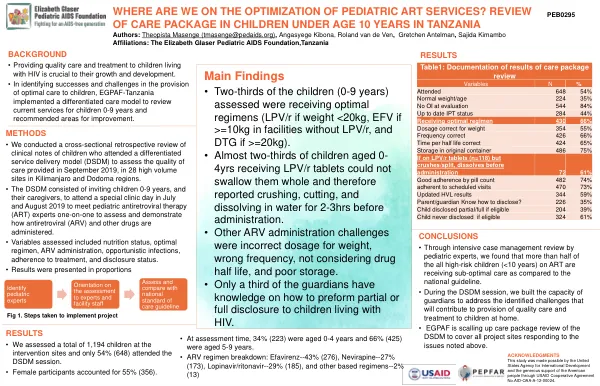
The model consisted of a special clinic day in July and August 2019, where children and their caregivers met pediatric antiretroviral therapy (ART) experts one-on-one to assess and demonstrate how antiretroviral (ARV) and other drugs are administered. A cross-sectional retrospective review of clinical notes of children who attended the differentiated service delivery model (DSDM) was conducted in 28 high-volume sites in Kilimanjaro and Dodoma regions in September 2019. The review assessed the quality of care provided, including nutrition status, optimal regimen, ARV administration, opportunistic infections, adherence to treatment, and disclosure status. The results were presented in proportions. Key findings from the review included that two-thirds of the children assessed were receiving optimal regimens, with the majority receiving lopinavir/ritonavir (LPV/r) tablets. However, almost two-thirds of children aged 0-4 years receiving LPV/r tablets could not swallow them whole and therefore reported crushing, cutting, and dissolving in water for 2-3 hours before administration. Other ARV administration challenges included incorrect dosage for weight, wrong frequency, not considering drug half-life, and poor storage. The review also found that only a third of guardians had knowledge on how to perform partial or full disclosure to children living with HIV. A total of 1,194 children were assessed at the intervention sites, with 54% (648) attending the DSDM session. Female participants accounted for 55% (356) of the total. The review revealed that more than half of the high-risk children under 10 years on ART were receiving sub-optimal care compared to the national guideline. Through intensive case management review by pediatric experts, the capacity of guardians was built to address the identified challenges, contributing to the provision of quality care and treatment to children at home. EGPAF is scaling up care package review of the DSDM to cover all project sites in response to the issues noted above. The review of care package in children under age 10 years in Tanzania highlighted the need for optimization of pediatric ART services. The results of the care package review are documented in Table 1, which shows the proportion of children who attended the DSDM session, had normal weight/age, were free of opportunistic infections, and were up to date with IPT status, among other variables. The review also found that 66% of children were receiving optimal regimens, and 74% had good adherence by pill count. However, 61% of children on LPV/r tablets crushed or split the tablets before administration, and 61% of children never disclosed their HIV status if eligible.