USAID
Global Climate Change: Standard Indicator Summary Sheet
Global Climate Change: Standard Indicator Summary Sheet is an updated document, revised on June 21, 2016.
2016 · 3 pages
Sign in to readA free account is required to download.
Abstract
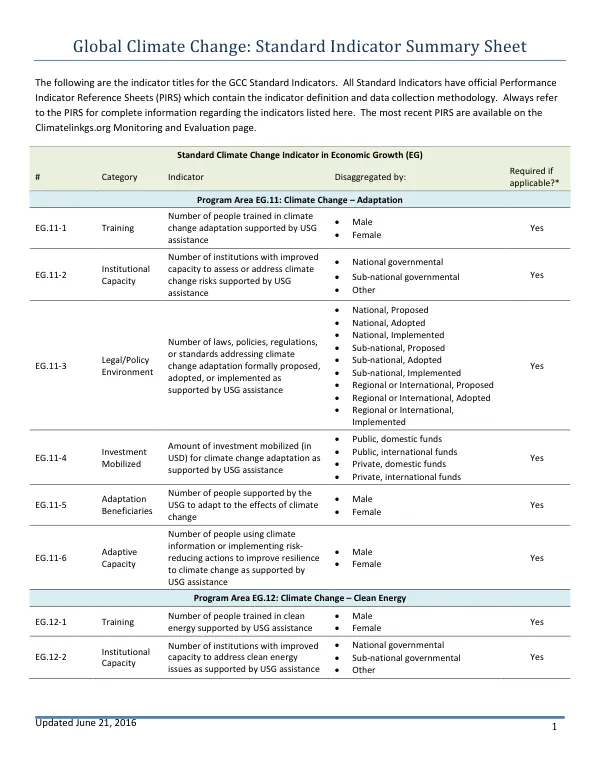
The document outlines the standard climate change indicators in economic growth, categorized under various program areas. These indicators are used to monitor and evaluate the impact of USG assistance on climate change adaptation and clean energy initiatives. The indicators are grouped under three program areas: EG.11: Climate Change – Adaptation, EG.12: Climate Change – Clean Energy, and EG.13: Climate Change – Sustainable Landscapes. Each indicator is further divided into subcategories, including training, institutional capacity, legal/policy environment, investment mobilized, and greenhouse gas emissions. For example, in the EG.11: Climate Change – Adaptation program area, indicators EG.11-1 through EG.11-6 track the number of people trained in climate change adaptation, the number of institutions with improved capacity to assess or address climate change risks, and the amount of investment mobilized for climate change adaptation. These indicators are disaggregated by sex, with separate values for male and female beneficiaries. Similarly, in the EG.12: Climate Change – Clean Energy program area, indicators EG.12-1 through EG.12-7 track the number of people trained in clean energy, the number of institutions with improved capacity to address clean energy issues, and the amount of investment mobilized for clean energy. These indicators also include metrics for clean energy generation capacity, greenhouse gas emissions reduced or avoided, and projected emission reductions. The indicators in the EG.13: Climate Change – Sustainable Landscapes program area, such as EG.13-1 through EG.13-7, track the number of people trained in sustainable landscapes, the number of institutions with improved capacity to address sustainable landscapes issues, and the amount of investment mobilized for sustainable landscapes. These indicators also include metrics for greenhouse gas emissions reduced or avoided and projected emission reductions. All USAID standard indicators are now considered Required As Applicable (RAA), meaning that an organization must report a result for each indicator if it is applicable to their activity design and funding requirements. This ensures accurate monitoring and reporting of the indicators.