USAID
Global Development Alliances & Agency Priorities
USAID pursues and supports Global Development Alliances (GDAs) as a means to increase the sustainable impact of its development assistance programs and more effectively address critical development challenges worldwide.
2012 · 5 pages
Sign in to readA free account is required to download.
Abstract
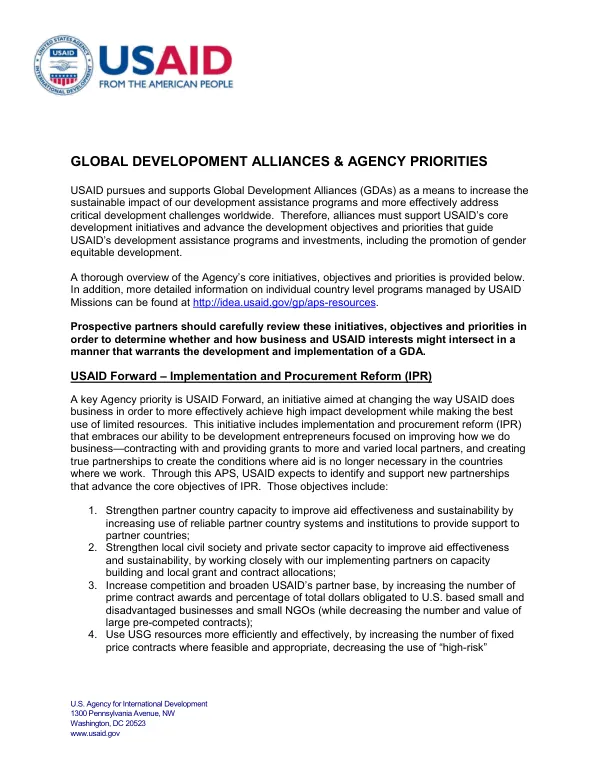
GDAs must support USAID's core development initiatives and advance the development objectives and priorities that guide USAID's development assistance programs and investments, including the promotion of gender equitable development. A key Agency priority is USAID Forward, an initiative aimed at changing the way USAID does business in order to more effectively achieve high impact development while making the best use of limited resources. This initiative includes implementation and procurement reform (IPR) that embraces USAID's ability to be development entrepreneurs focused on improving how it does business. Through IPR, USAID expects to identify and support new partnerships that advance the core objectives of IPR, including strengthening partner country capacity, strengthening local civil society and private sector capacity, increasing competition and broadening USAID's partner base, using USG resources more efficiently and effectively, and strengthening collaboration and partnership with bilateral donors, multilateral and international organizations. Food security is a priority for the Administration, and USAID is the lead implementing agency for the President's global hunger and food security initiative, Feed the Future. One billion people live in poverty and chronic hunger, and this number appears to be rising. Engagement of the private sector is critical to the success and sustainability of this initiative. Mobilizing private financing – equity and debt – in key value chains in target countries will be an important component to achieve scale. Partnerships can accelerate actions that improve the ability of millions of food-insecure families to increase production of food staples, improve nutrition for the vulnerable, and increase household income. In support of climate change adaptation and mitigation, USAID is interested in supporting partnerships that address gender equal implementation of policy reform, institutional modification, and/or the stakeholder involvement required for low-emission, climate-resilient development. USAID is also interested in partnerships with private fund managers and other investors or financial institutions that demonstrate innovative approaches to significantly increase financing for businesses and projects that have measurable emission reductions. USAID's Global Climate Change program is pursuing activities against two objectives—adaptation and mitigation—using three funding streams or “pillars”: adaptation, clean energy, and sustainable landscapes. The Administration is emphasizing global health in its diplomacy and development work around the world. With strategic investments in global health, USAID will spur progress in economic development, job creation, education, agricultural development, gender equity, and political stability. Through the Global Health Initiative (GHI), the U.S. government is pursuing the dual objectives of achieving significant health improvements and creating an effective, efficient, and country-led platform for the sustainable delivery of essential health care and public health programs. The GHI will help partner countries improve health outcomes through strengthened health systems, with a particular focus on improving the health of women, newborns, and children through programs including infectious disease, nutrition, maternal and child health, family planning and reproductive health, and safe water. Water is a basic requirement for human health, livelihoods, food security, and ecosystem integrity. USAID's strategy for the water sector reflects the integrated nature of the sector and includes attention to all dimensions of water and development, including water supply, sanitation and hygiene, gender equality, sustainable water resources management, the financing of water and sanitation delivery systems, and productive water use in economic sectors such as agriculture and industry. Through this APS, USAID hopes to elicit new partners for its Missions and Washington Operating Units (WOUs) that will create innovative GDAs that can have a significant impact on development challenges across the entire spectrum of water-related development issues. Continued progress in science, technology, and innovation with improved application of technology in development is critical to the President's goal of increasing the number of prosperous, capable, and democratic states. Input of U.S. science, technology, and innovation is sought by developing countries to support broad-based economic growth and critical concerns such as food security, education, gender equality, public health, and global climate change. To address these needs, USAID is elevating the role of science, technology, and innovation in shaping development strategies. Partnerships with the private sector are fundamental to successful utilization of high-risk, high-payoff approaches. Special emphasis will be placed on bridging the gap between national and local innovation systems and the global market.
Related documents