JOHNS HOPKINS UNIVERSITY
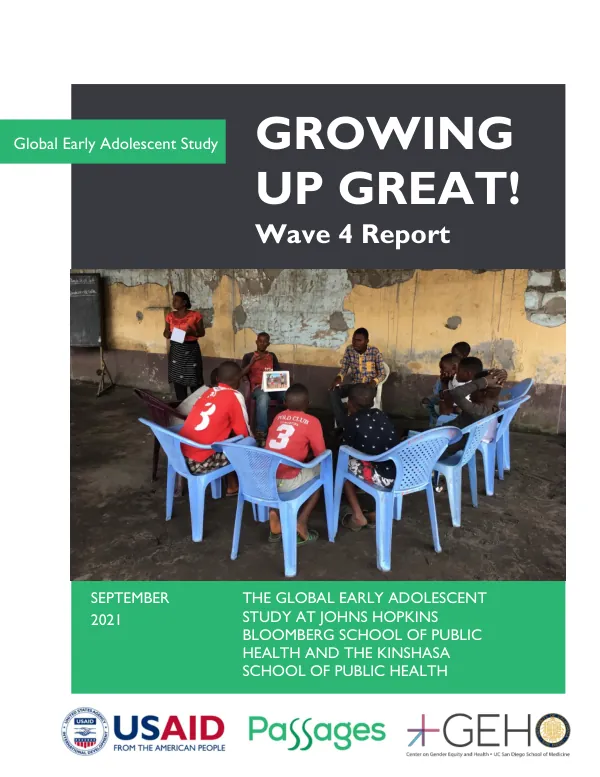
Global Early Adolescent Study in Kinshasa: Wave 1 Results
The Global Early Adolescent Study in Kinshasa employed a quasi-experimental design with two arms: intervention and control.
2018 · 32 pages
Sign in to readA free account is required to download.

Abstract
The study was conducted in two neighborhoods, Masina and Kimbanseke, with a total of 40 schools stratified by school type. From each of these schools, 25 adolescents were randomly selected for participation in the study. The sampling procedure involved two groups: in-school (IS) and out-of-school (OOS) adolescents. The IS group consisted of 1001 participants from 40 schools, while the OOS group comprised 377 participants from the same schools. Additionally, 443 OOS adolescents were selected from a household roster of adolescents aged 10-14, stratified by age and sex. This resulted in a total of 400 adolescents in each study group. The adolescent context in Kinshasa is characterized by significant socio-economic disparities. School enrollment status is a key determinant of socio-economic status, with OOS adolescents more likely to experience economic difficulties and school discontinuation. Family structure also varies by school enrollment, with OOS adolescents less likely to live in two-parent households. However, sibling composition is similar between IS and OOS adolescents. Caregiver relationships differ between IS and OOS adolescents, with OOS adolescents exhibiting lower caregiver connectedness but greater caregiver awareness. Additionally, OOS adolescents have lower perceived parental aspirations for education and earlier perceived marital expectations compared to IS adolescents. Peer networks also vary between IS and OOS adolescents, with OOS adolescents spending more time with friends and boys' friend networks being more mixed than girls'. The neighborhood context in Kinshasa is also an important factor in adolescent development. Boys are more trusting of their neighborhood environment but more likely to feel threatened than girls. These findings highlight the complex interplay of socio-economic, family, and neighborhood factors that shape the lives of early adolescents in Kinshasa.