USAID DEC
Analysis of adenovirus DNA detected in rodent species from the Democratic Republic of the Congo indicates potentially novel adenovirus types
Sign inELSEVIER LTD.
Analysis of adenovirus DNA detected in rodent species from the Democratic Republic of the Congo indicates potentially novel adenovirus types
Adenoviruses (AdVs) are double-stranded DNA viruses with a linear, non-segmented genome.
2020 · 6 pages
Sign in to readA free account is required to download.
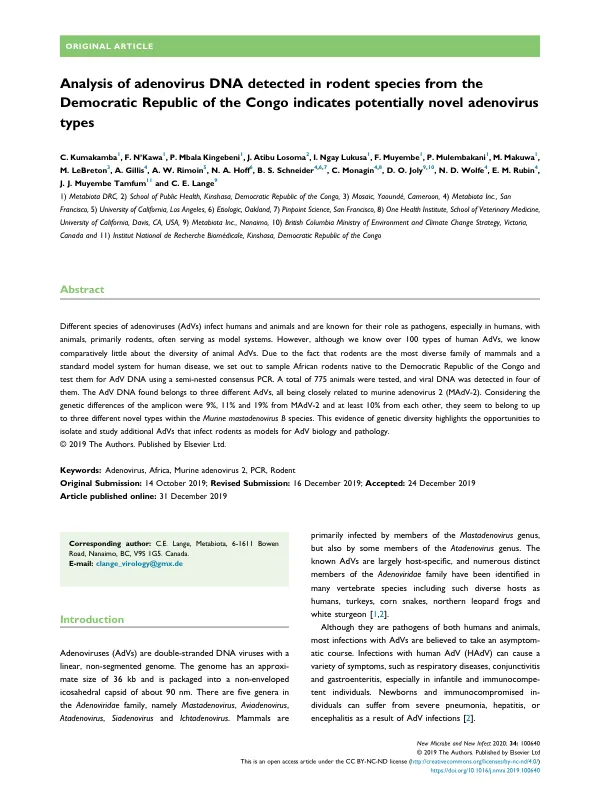
Abstract
The genome has an approximate size of 36 kb and is packaged into a non-enveloped icosahedral capsid of about 90 nm. There are five genera in the Adenoviridae family, namely Mastadenovirus, Aviadenovirus, Atadenovirus, Siadenovirus, and Ichtadenovirus. Mammals are primarily infected by members of the Mastadenovirus genus, but also by some members of the Atadenovirus genus. The known AdVs are largely host-specific, and numerous distinct members of the Adenoviridae family have been identified in many vertebrate species, including humans, turkeys, corn snakes, northern leopard frogs, and white sturgeon. The diversity of AdVs is very high, with over 100 different human AdV types described so far. Despite the high AdV diversity, much of what is known about their biology is based on work with rodent-based model systems. Murine AdV-1 (MAdV-1) is probably one of the best-understood rodent-specific AdVs today. Much like in humans, AdV infections of immunocompetent mice rarely result in clinical disease, whereas immunocompromised or newborn mice can suffer from similar symptoms to their human counterparts. Serological studies suggest that infections among wild rodents may be common, but only a handful of different rodent AdVs were known until recently. Increasing evidence, such as the amplification of novel sequences from rodents in China and Cameroon, suggests that there are many more yet to be discovered. A study was conducted to screen a diverse set of rodents found in the Democratic Republic of the Congo (DRC) for evidence of AdVs and evaluate their relation to known types. Samples were collected between December 2010 and June 2013 from rodents in several locations in DRC. The animals were sampled as part of a larger research program that aimed to investigate the sharing of viruses between animals and humans, and rodent infections were of critical importance to the research goal. A total of 775 animals were tested, and viral DNA was detected in four of them. The AdV DNA found belongs to three different AdVs, all being closely related to murine adenovirus 2 (MAdV-2). The genetic differences of the amplicon were 9%, 11%, and 19% from MAdV-2 and at least 10% from each other, suggesting that they may belong to up to three different novel types within the Murine mastadenovirus B species. This evidence of genetic diversity highlights the opportunities to isolate and study additional AdVs that infect rodents as models for AdV biology and pathology. The study's findings provide new insights into the diversity of AdVs and the potential for novel AdV types to be discovered in rodents. The results also emphasize the importance of continued research into the biology and pathology of AdVs, particularly in the context of rodent-based model systems.