USAID DEC
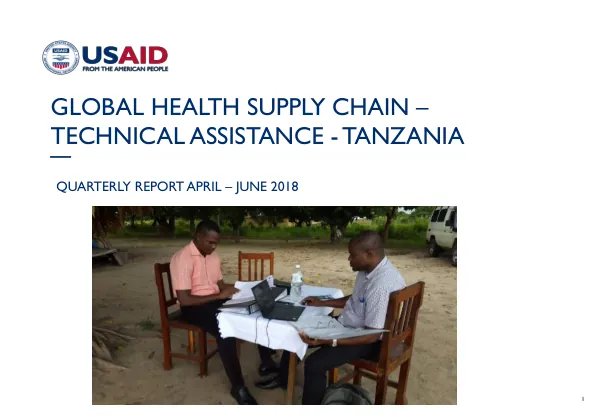
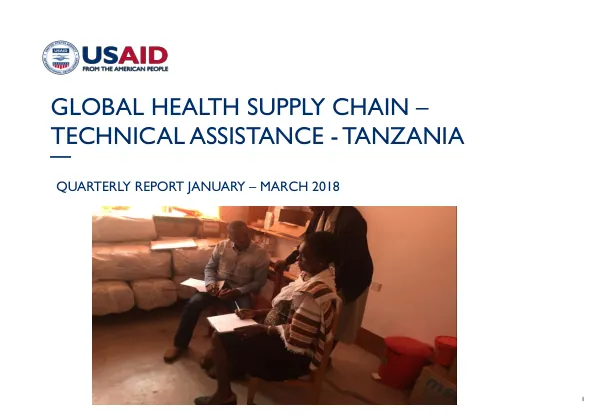
Global Health Supply Chain – Technical Assistance - Tanzania: Quarterly Report January – March 2018
Sign inNATIONAL MALARIA CONTROL PROGRAM
Global Health Supply Chain – Technical Assistance - Tanzania: Quarterly Report January – March 2018
The Global Health Supply Chain - Technical Assistance - Tanzania project aims to support the development of agile, robust, and sustainable health supply chains that contribute to improving medicines availability and the health status of Tanzanians.
2018 · 58 pages
Sign in to readA free account is required to download.
Abstract
The project's goal is to align stakeholders on national supply chain objectives, harmonize strategic documents with supply chain goals, and hold stakeholders accountable for their contributions towards strategic plans. The project focuses on four key areas: assist in operationalizing strategic plans, support supply chain costing and financing strategies, strengthen supply chain information systems and improve data visibility, and support the logistics management unit. The project works with key stakeholders, including the Ministry of Health, Community Development, Gender, Elderly and Children (MOHCDGEC), the Pharmaceutical Services Unit (PSU), vertical programs, the Medical Stores Department (MSD), and other partners. In the January-March 2018 quarter, the project achieved several key accomplishments. In the area of assist in operationalizing strategic plans, the project supported the development of standardized national health supply chain key performance indicators (KPIs). A workshop was conducted in Morogoro to develop the first draft of KPIs, which involved a range of stakeholders including MOHCDGEC, PO-RALG, WHO, TFDA, and implementing partners. The KPI Reference Manual was drafted and will be finalized in the next quarter. In the area of support supply chain costing and financing strategies, the project conducted an assessment to estimate the total health commodities financial needs at primary health care facilities, the amount of available funds to cover those needs, and the financial gap. Preliminary results indicate that the unmet health commodities needs for dispensaries, district hospitals, and health centers are on average of 20%, 13%, and 20% respectively. Approximately, on average 8% of the financial needs are covered by MSD. The project also provided technical assistance in the development of Monitoring and Evaluation (M&E) framework, supervision and mentorship guide for regional and council management teams, and performance enhancing tools for health facilities and health facility governing committees with a special focus on health commodities availability. The project conducted a study to estimate total health commodity financial needs, available funds, and financial gaps, and developed M&E framework supervision and mentorship guide, and performance enhancing tools for national master trainers. In addition, the project worked with MoHCDGEC and PoRALG to agree on an action plan to have Government of Tanzania Hospital Management Information Systems (GoTHOMIS) integration with eLMIS. The project also worked on preliminary steps to transition eLMIS to National internet data center. The project reviewed and approved 10,287 R&R to ensure data quality, visited 177 health facilities in 23 councils, and provided on-job-training to 220 health care workers. The project's quarterly work stream accomplishments include assisting in operationalizing strategic plans, supporting supply chain costing and financing strategies, strengthening supply chain information systems and improving data visibility, and supporting the logistics management unit. The project's key KPIs include percent of activities carried out in accordance with Costed Implementation Plan (CIP) from HSCR recommendations, forecast accuracy, order fill rate, on-time delivery, percent of key position vacant (related to supply chain), percent of items procured that are in approved standard commodity list, stock availability, DQA pass rate (R&R that pass quality check), reliability rate of lab equipment, percent of product procured as per supply plan, wastage from damage, theft, and expiry, and reporting rate (complete and on time). The project's focus for the January-March period was to standardize national key performance indicators for health supply chain, support health financing needs assessment, and planning for the implementation of DHFF integrated approach. The project's activities included conducting an assessment to estimate the total health commodities financial needs, developing M&E framework supervision and mentorship guide, and performance enhancing tools for national master trainers, and providing technical assistance in the development of Monitoring and Evaluation (M&E) framework, supervision and mentorship guide for regional and council management teams, and performance enhancing tools for health facilities and health facility governing committees with a special focus on health commodities availability. The project's accomplishments in the January-March 2018 quarter demonstrate its commitment to supporting the development of agile, robust, and sustainable health supply chains in Tanzania. The project's focus on operationalizing strategic plans, supporting supply chain costing and financing strategies, strengthening supply chain information systems and improving data visibility, and supporting the logistics management unit will contribute to improving medicines availability and the health status of Tanzanians.
Related documents