INTERNATIONAL FOOD AND POLICY RESEARCH INSTITUTE
Good Practice Note: Farmer-to-Farmer Extension
The Farmer-to-Farmer Extension (F2FE) approach is a community-based extension method that involves the provision of training by farmers to farmers.
2015 · 4 pages
Sign in to readA free account is required to download.
Abstract
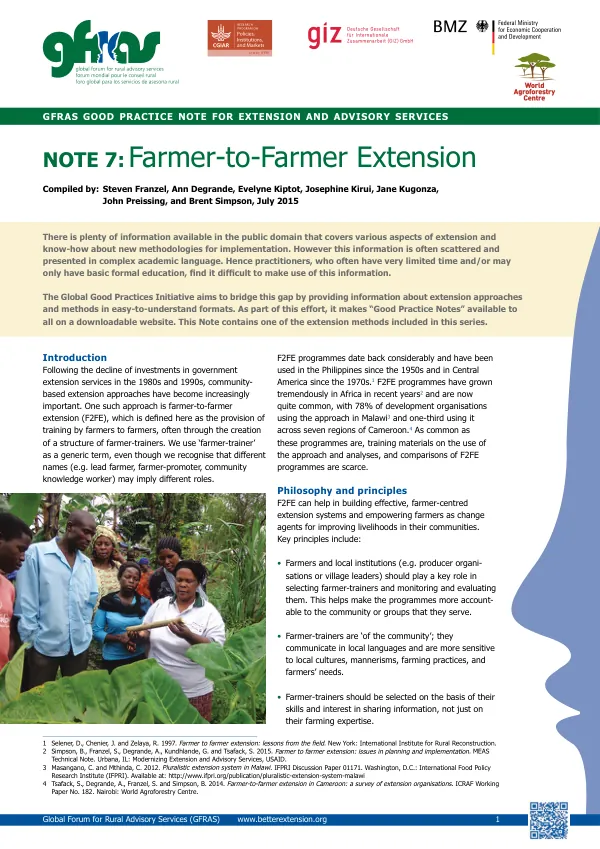
This approach has been used in various countries, including the Philippines since the 1950s and in Central America since the 1970s. In Africa, F2FE programmes have grown significantly in recent years, with 78% of development organisations using the approach in Malawi and one-third using it across seven regions of Cameroon. F2FE can help build effective, farmer-centred extension systems and empower farmers as change agents for improving livelihoods in their communities. Key principles of F2FE include the selection of farmer-trainers by farmers and local institutions, the use of local languages and cultures, and the selection of farmer-trainers based on their skills and interest in sharing information. Farmer-trainers need strong linkages with and support from development agents, and facilitating organisations and local institutions need to be proactive in ensuring that women as well as men become farmer-trainers. The implementation of F2FE involves assessing whether the approach is appropriate for the farmers and region in question, selecting farmer-trainers, and providing them with training and support. Farmer-trainers train farmers on a wide range of practices, including livestock, crops, agroforestry, and fisheries. They also serve as a complement to existing extension systems, rather than being a substitute for them. Many organisations compensate farmer-trainers for some expenses, such as transportation or airtime for mobile phones, but only a few pay them salaries or allowances. Farmer-trainers need training in both technical aspects and communication. Most organisations start with several days of residential training, involving presentations, field activities, and field tours. Periodic training, field backstopping, and on-the-job training are also important for maintaining farmer-trainers' motivation and ensuring they have something of value to offer others. The main costs of an F2FE programme are training, follow-up training, and incentives to motivate farmer-trainers. A survey of 80 organisations using F2FE in Cameroon, Kenya, and Malawi found that they valued the approach because it was low-cost, helped extension services expand their reach, and improved accountability to the community. Many also reported that farmers' command of local languages and culture helped promote uptake of new practices. Some reported that F2FE programmes also promote feedback on new practices to research and extension and help strengthen the capacity of communities to access information. The F2FE approach has several strengths, including its low cost, ability to expand the reach of extension services, and improved accountability to the community. However, it also has some weaknesses, including the need for strong linkages with and support from development agents and the potential for farmer-trainers to be seen as a substitute for existing extension systems. Overall, F2FE is a valuable approach for building effective, farmer-centred extension systems and empowering farmers as change agents for improving livelihoods in their communities.