USAID DEC
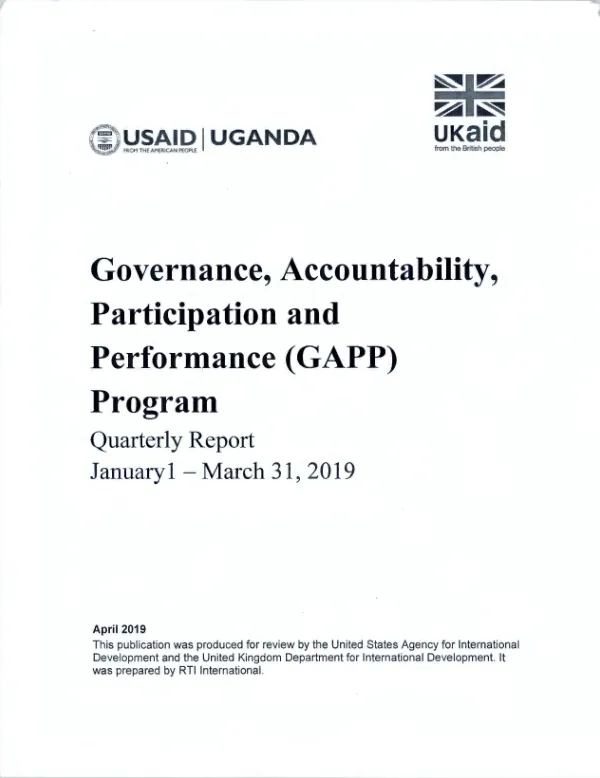
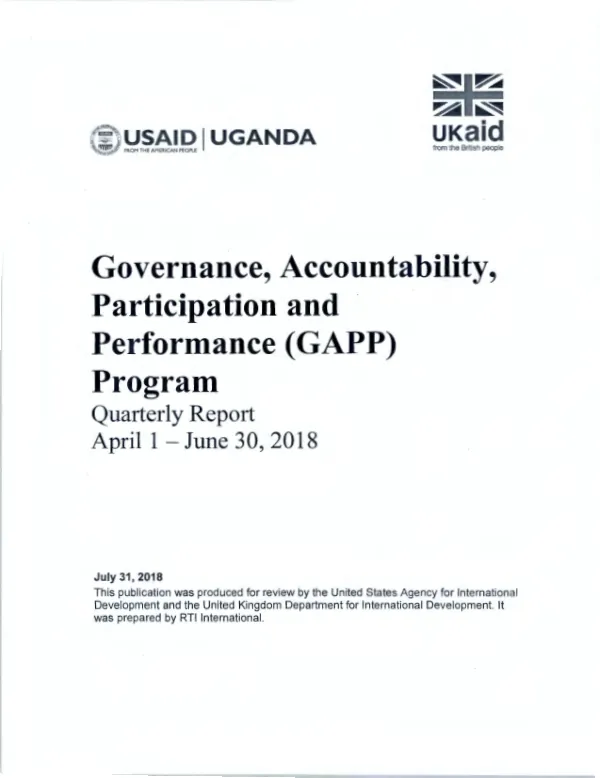
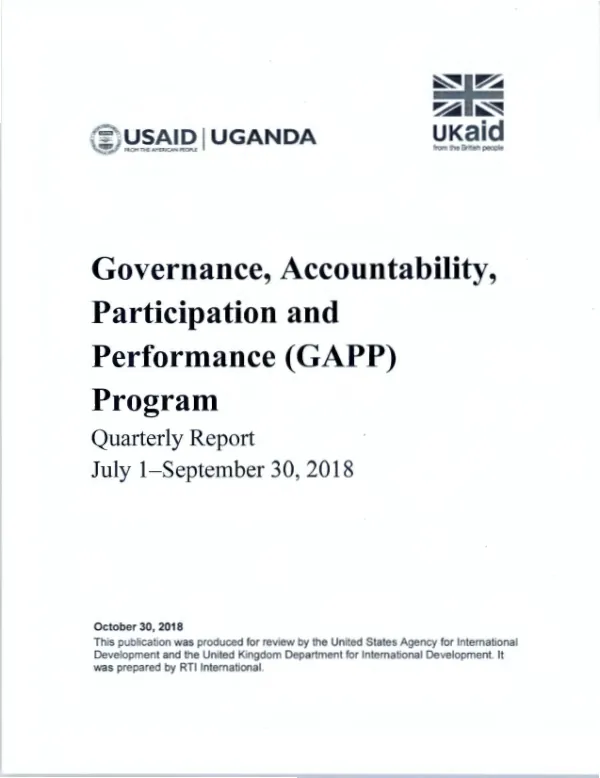
Governance, Accountability, Participation and Performance (GAPP) Program Quarterly Report July 1-September 30, 2018
Sign inRTI INTERNATIONAL
Governance, Accountability, Participation and Performance (GAPP) Program Quarterly Report July 1-September 30, 2018
The Governance, Accountability, Participation and Performance (GAPP) Program is a USAID-funded initiative implemented in Uganda from July 1 to September 30, 2018.
2018 · 72 pages
Sign in to readA free account is required to download.
Abstract
The program aimed to improve governance, accountability, and participation in local governments, with a focus on strengthening the capacity of national accountability institutions, local governments, and civil society organizations. Component 1 of the program focused on improving the legal, policy, regulatory, and institutional environment. This involved strengthening the capacity of national accountability institutions to support local government accountability, as well as promoting national stakeholder policy collaboration and dialogue on local government accountability, financing, and service delivery. Sub-IR 1.1 aimed to improve the capacity of national accountability institutions, while Sub-IR 1.2 focused on strengthening national stakeholder policy collaboration and dialogue. Component 2 of the program focused on strengthening local government fiscal management, accountability, and decision-making. This involved strengthening local government accountability systems, as well as providing technical assistance to the Ministry of Local Government. Sub-IR 2.2 aimed to strengthen local government accountability systems, while TA to MOLG provided technical assistance to the Ministry of Local Government. Component 3 of the program focused on voice and accountability. This involved increasing private sector participation in local governance, improving the institutional capacity of civil society organizations and private sector associations, increasing advocacy by civil society organizations and private sector associations, and increasing citizen awareness and engagement with local governments. Sub-IR 3.1 aimed to increase private sector participation in local governance, while Sub-IR 3.2 focused on improving the institutional capacity of civil society organizations and private sector associations. The program also provided technical assistance to the Ministry of Health and the Refugee Intervention, as well as collaboration, learning, and adapting (CLA) activities. The program's management and administrative issues were also addressed, including financial management and procurement. The GAPP program's theory of change is based on the idea that improved governance, accountability, and participation in local governments will lead to better service delivery and improved livelihoods for citizens. The program's methodologies include a range of activities, including training, capacity building, and technical assistance. The program's progress was monitored and evaluated through a range of indicators, including the number of local governments that have implemented improved accountability systems, the number of civil society organizations that have increased their participation in local governance, and the number of citizens who have increased their awareness and engagement with local governments. The program's financial management was also a key focus area, with the program working to improve the capacity of local governments to manage their finances effectively. The program also worked to improve the procurement processes of local governments, to ensure that they are transparent and accountable. Overall, the GAPP program aimed to improve governance, accountability, and participation in local governments in Uganda, with a focus on strengthening the capacity of national accountability institutions, local governments, and civil society organizations. The program's progress was monitored and evaluated through a range of indicators, and its financial management was a key focus area.
Related documents