DEPARTMENT OF HEALTH
Governing for Quality Improvement in the Context of UHC: Philippines
The Philippine Health Insurance Corporation, or PhilHealth, was established in 1995 to administer the National Health Insurance Program, which aims to provide financial access to health services to all Filipinos.
2015 · 4 pages
Sign in to readA free account is required to download.
Abstract
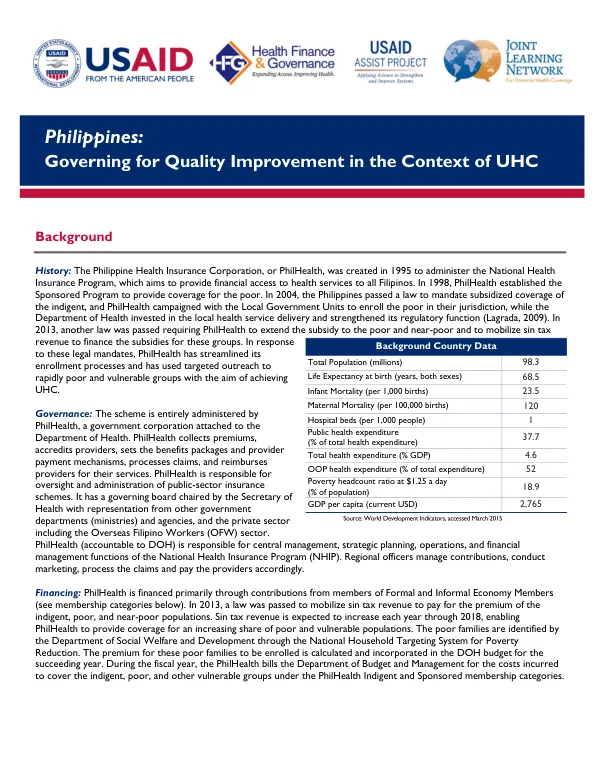
The program's primary goal is to achieve Universal Health Coverage (UHC) by providing subsidized coverage to the poor and vulnerable populations. PhilHealth is governed by a board chaired by the Secretary of Health, with representation from other government departments and agencies, as well as the private sector. The corporation is responsible for collecting premiums, accrediting providers, setting benefits packages and provider payment mechanisms, processing claims, and reimbursing providers for their services. PhilHealth is financed primarily through contributions from members of the Formal and Informal Economy Members. In 2013, a law was passed to mobilize sin tax revenue to pay for the premium of the indigent, poor, and near-poor populations. The poor families are identified by the Department of Social Welfare and Development through the National Household Targeting System for Poverty Reduction. The Philippines has a total population of 98.3 million, with a life expectancy at birth of 68.5 years and an infant mortality rate of 23.5 per 1,000 births. The country's public health expenditure accounts for 37.7% of the total health expenditure, while the out-of-pocket health expenditure accounts for 52% of the total expenditure. PhilHealth has implemented several quality reforms to improve the quality of care provided to its beneficiaries. These reforms include increasing the operational capacity of PhilHealth, developing and scaling up of IT systems, simplifying the accreditation process, and empowering PhilHealth beneficiaries. The corporation has also implemented the PhilHealth Benchbook, which established standards for accreditation, and created the Quality Assurance Committee to recommend clinical practice guidelines. PhilHealth has also faced several challenges in promoting quality of care, including the fragmentation of IT systems, inadequate capacity to review and decide on cases related to poor quality of care, and different understanding of quality care between patients and healthcare providers. To address these challenges, PhilHealth has adopted several approaches, including the use of licensing, accreditation, and contracting mechanisms, investing in public-provided health services, and regular updating and implementation of National Drug Formulary. The Philippines has made significant progress in achieving UHC, with a 27% increase in household income among program participants compared to the control group.