CLINTON HEALTHCARE ACCESS INITIATIVE
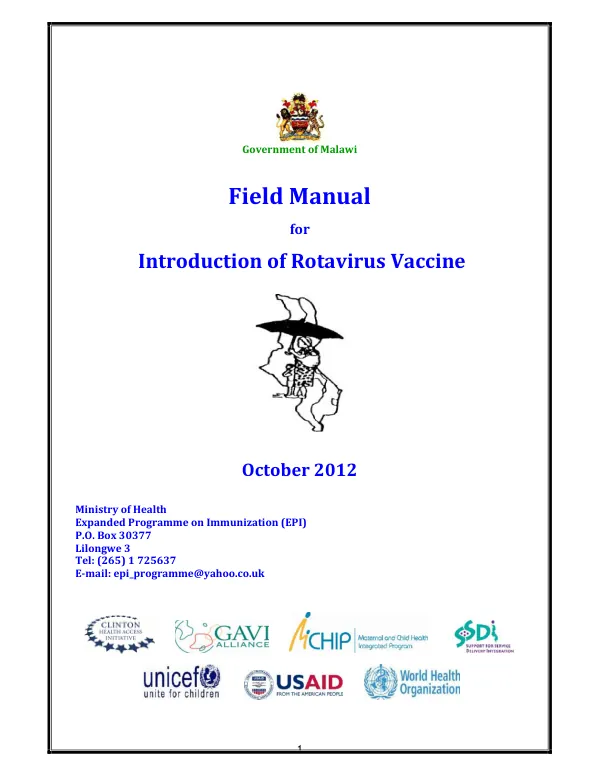
Government of Malawi Field Manual for Introduction of Rotavirus Vaccine
The introduction of the Rotavirus vaccine in Malawi began in October 2012, with the Ministry of Health, in collaboration with the GAVI Alliance and other partners, aiming to protect children under five from severe diarrhoea caused by the Rotavirus.
2012 · 46 pages
Sign in to readA free account is required to download.
Abstract
The vaccine, Rotarix, provides approximately 90-100% protection against severe Rotavirus disease and 74-85% protection against Rotavirus diarrhoea of any severity. The vaccine targets children below one year of age and will be administered as part of the national infant immunization schedule. The Rotavirus vaccine schedule involves two doses, with the first dose to be administered at 6 to 15 weeks and the second dose before 32 weeks, with a minimum interval of 4 weeks between the first and second doses. The vaccine will be administered at the same time as other existing routine vaccines given at 6 and 10 weeks. Healthcare workers should be aware of the importance of adhering to the recommended schedule to ensure the effectiveness of the vaccine. The Ministry of Health is committed to the prevention and control of vaccine-preventable diseases in Malawi, and the introduction of the Rotavirus vaccine is expected to contribute to the achievement of the Millennium Development Goals (MDG 4). The Ministry believes that the concerted efforts of all stakeholders involved in the introduction of the Rotavirus vaccine will lead to a smooth introduction and improved immunization service delivery for the benefit of all infants in Malawi. The Expanded Programme on Immunization (EPI) has developed a field manual to guide healthcare workers, managers, and EPI coordinators in the introduction and administration of the Rotavirus vaccine. The manual provides general information on best practices for managing immunization services and specific information on the handling of the Rotarix vaccine. It also includes information on adverse events following immunization (AEFI) and the management of vaccine reactions. The manual acknowledges the contributions of various partners, including the World Health Organization, the United Nations Children's Fund, the Clinton Health Access Initiative, and the United States Agency for International Development, among others. The Ministry of Health is grateful to the Clinton Health Access Initiative for financial support for the printing of the training manual.