USAID DEC
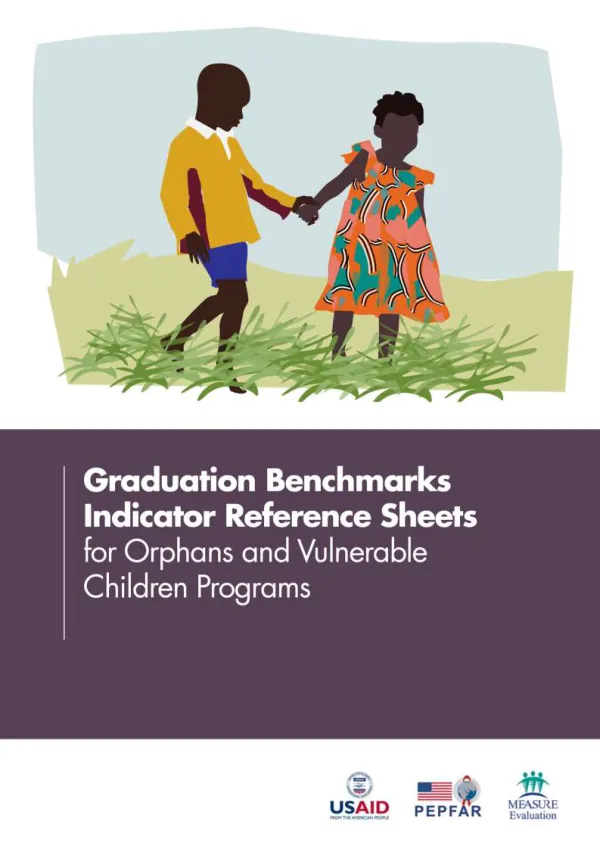
Graduation Benchmarks Indicator Reference Sheets for Orphans and Vulnerable Children Programs
Sign inUSAID
Graduation Benchmarks Indicator Reference Sheets for Orphans and Vulnerable Children Programs
The Graduation Benchmarks Indicator Reference Sheets for Orphans and Vulnerable Children Programs outline a set of indicators to measure the progress of children and their caregivers in achieving key milestones.
2019 · 19 pages
Sign in to readA free account is required to download.
Abstract
The benchmarks are categorized into three main areas: HIV status, viral suppression, and knowledge about HIV prevention. Benchmark 1, known HIV status, aims to increase the diagnosis of HIV infection among children, adolescents, and caregivers. The indicator assesses whether all household members have known HIV status or have been assessed as "test not required based on risk." The data source includes casefiles, HIV risk assessment tools, and follow-up/case monitoring reports. The caseworker conducts an initial HIV risk assessment for all household members and repeats it whenever there is a change in HIV risk. To meet this benchmark, the household must have all children, adolescents, and youth (ages 0-17 and 18-20 if still in secondary school) with known HIV status or assessed as "test not required based on risk." Primary caregivers (ages 18+) must also have known HIV status or be assessed as "test not required based on risk." The caseworker collects data on primary caregivers' report of HIV test results for children in their care, caregivers' self-report of HIV test results, and caregivers' self-report of HIV test results for HIV-exposed infants. Benchmark 2, virally suppressed, aims to increase HIV treatment adherence, retention, and viral suppression among children, adolescents, and caregivers living with HIV. The indicator assesses whether all HIV-positive household members have been virally suppressed (<1,000 copies/mL) for the last 12 months or have adhered to antiretroviral therapy (ART) for at least the last 12 months. The data source includes casefiles, and the caseworker conducts an ART assessment at each home visit. To meet this benchmark, the household must have all HIV-positive children, adolescents, and youth (ages 0-17 and 18-20 if still in secondary school) virally suppressed or have adhered to ART for 12 months. Primary caregivers living with HIV (ages 18+) must also be virally suppressed or have adhered to ART for 12 months. Benchmark 3, knowledgeable about HIV prevention, aims to reduce the risk of HIV infection among adolescents. The indicator assesses whether all adolescents (ages 10-17) have key knowledge about preventing HIV infection. The data source includes the OVC Graduation Benchmarks Assessment Tool, and the caseworker collects data when the household is assessed for graduation. To meet this benchmark, the household must have all adolescents (ages 10-17) correctly answer all questions about HIV knowledge in the OVC Graduation Benchmarks Assessment Tool. The caseworker asks each adolescent to describe at least two HIV infection risks in their local community and provide at least one example of how they can help protect themselves against HIV risk. The benchmarks are essential in measuring the progress of children and their caregivers in achieving key milestones. They provide a framework for caseworkers to assess the household's progress and make informed decisions about graduation. The data collected through these benchmarks can also inform programmatic decisions and resource allocation to support the needs of orphans and vulnerable children.
Related documents