FOOD AND AGRICULTURAL ORGANIZATION
Greenhouse Gas Emissions in Guatemala
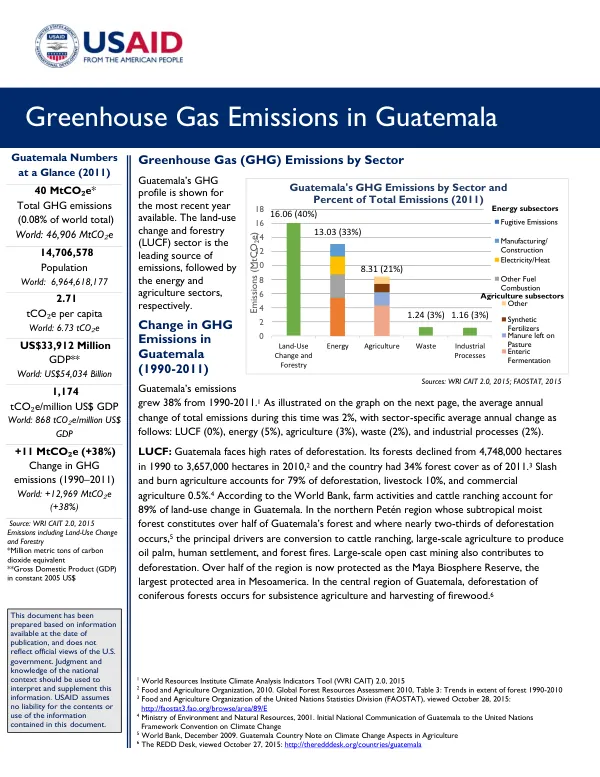
Guatemala's greenhouse gas (GHG) emissions profile is characterized by the land-use change and forestry (LUCF) sector as the leading source of emissions, followed by the energy and agriculture sectors.
2015 · 2 pages
Sign in to readA free account is required to download.
Abstract
The LUCF sector accounts for 40% of total emissions, primarily due to deforestation, with slash and burn agriculture responsible for 79% of deforestation. The country's forests declined from 4,748,000 hectares in 1990 to 3,657,000 hectares in 2010, resulting in a 23% decrease in forest cover. The energy sector is the second-largest contributor to GHG emissions, with national energy consumption in 2012 consisting of wood (57%), petroleum products (34%), and electricity (10%). Wood is mainly used for cooking by poor households in rural, non-electrified areas, while petroleum products are mainly used by the industrial and transportation sectors for heat generation. Guatemala's Energy Policy aims to achieve a secure supply of electricity and fuels at competitive prices, including by diversifying the energy mix to include 80% share of renewables by 2027. The agriculture sector is also a significant contributor to GHG emissions, with livestock responsible for the great majority of agriculture sector emissions. Land degradation stands at 33%, very close to the Latin American average of 35%. However, Guatemala has shown growth in non-traditional agriculture exports, with production of snow peas, green beans, baby/mini-vegetables, and fruits increasing exponentially over the past decade, benefiting smallholder farmers. Guatemala's GDP grew from US$15.7 billion in 1990 to US$33.9 billion in 2011, resulting in a decrease in carbon intensity of the economy relative to 1990. The country has pledged to achieve an unconditional reduction in total GHG emissions of 11.2% by 2030, with the goal of capping its 2030 emissions at 41.66 MtCO2e. The Intended Nationally Determined Contribution (INDC) identifies the forestry, agriculture, and transportation sectors as most in need of support, with a focus on improving urban mobility using efficient mass transportation. The country's energy policy sets targets for achieving a secure supply of electricity and fuels at competitive prices, including by diversifying the energy mix to include 80% share of renewables by 2027. The policy also aims to achieve 25% energy savings in industry and commercial sectors, reducing industry's use of firewood by 15%, increasing the surface of "energy forest plantations" by 10%, and reducing use of firewood through efficient stoves and substituting wood with other energy sources in 25% of households. Guatemala's population was approximately 14.7 million in 2011, with a per capita GHG emissions of 2.71 tCO2e. The country's total GHG emissions were 40 MtCO2e, representing 0.08% of the world's total emissions. The country's GDP was US$33.9 billion in 2011, with a carbon intensity of 1,174 tCO2e/million US$ GDP.