USAID
Saint Lucia Resilience Profile
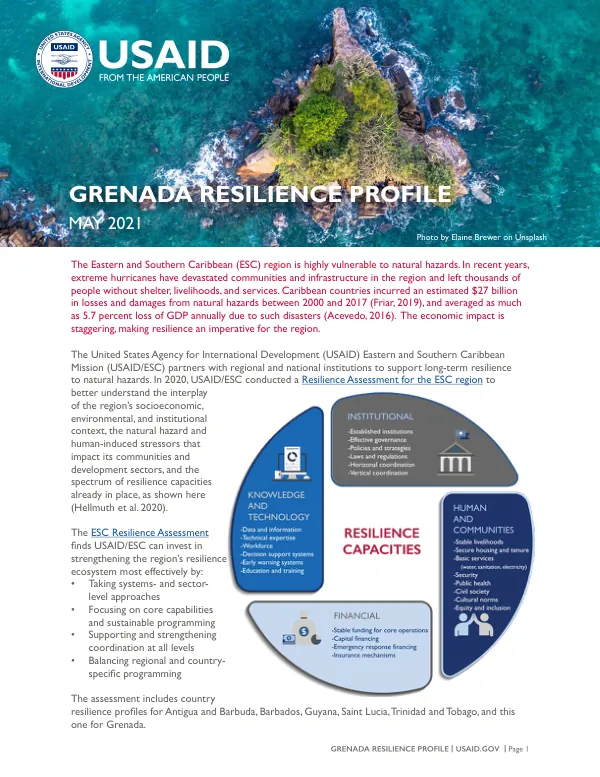
The Eastern and Southern Caribbean region is highly vulnerable to natural hazards, with extreme hurricanes devastating communities and infrastructure in recent years.
2021 · 7 pages
Sign in to readA free account is required to download.
Abstract
The region incurred an estimated $27 billion in losses and damages from natural hazards between 2000 and 2017, averaging 5.7 percent loss of GDP annually due to such disasters. The economic impact is staggering, making resilience an imperative for the region. Saint Lucia, a small island nation in the Eastern Caribbean, is particularly vulnerable to natural hazards, including storms, flooding, landslides, drought, changing climate conditions, earthquakes, and volcanic activity. The country's population is clustered along its coast, with steep mountains prohibiting inward expansion. While Saint Lucia enjoys high education and life expectancy rates, poverty and unemployment are pervasive, with a high youth unemployment rate of 31.6 percent. The country's regulatory framework is guided by three main policies: The Disaster Management Act of Saint Lucia 2006, the National Emergency Management Plan, and the National Comprehensive Disaster Management Strategy. The Disaster Management Act established the National Emergency Management Organization (NEMO), which is responsible for developing, testing, and implementing measures to protect the population from the physical, social, environmental, and economic effects of both natural and man-made disasters. Saint Lucia's priority risks from natural hazards and climate change include flooding, landslides, drought, and sea level rise. Flooding is a major concern, particularly in low-lying areas and coastal villages, which already suffer from socioeconomic inequities and minimal social protection instruments. The country has experienced significant damage from flood events, including a 2013 event that resulted in a total loss of $99.88 million, equivalent to 8.3 percent of Saint Lucia's GDP. The country's resilience capacities are unique and include a functional five-year pathway for resilience, which is one of the first countries to have such a plan. Saint Lucia also has a strong regulatory framework, with policies and laws in place to support disaster resilience-related initiatives. However, the country faces significant challenges in preparing for the hurricane season due to lack of financial resources, exacerbated by the COVID-19 pandemic. The Saint Lucia Resilience Profile highlights the country's vulnerability to natural hazards and climate change, as well as its resilience capacities and challenges. The profile provides a comprehensive overview of the country's risk and resilience profile, including its priority risks, resilience capacities, and institutional context and legal framework affecting resilience. The profile is intended to support USAID's efforts to strengthen the region's resilience ecosystem and provide a foundation for future resilience programming in Saint Lucia. Saint Lucia's geographic location and topography make it prone to natural hazards, including storms, flooding, landslides, and drought. The country's narrow coastal strip is characterized by concentrations of haphazard and unplanned development, which increases the risk of damage from natural hazards. The country's environmental context is also characterized by a tropical maritime climate, with a historical mean annual temperature of 25.6°C and precipitation of 2330.1mm. The country's social context is characterized by a multi-ethnic and multi-religious population, with a high Human Development Index value of 0.745. However, poverty and unemployment are pervasive, with a high youth unemployment rate of 31.6 percent. The country's economic context is characterized by a relatively low level of economic growth, with tourism being the main source of economic activity. The country's GDP per capita is $8,162, and the annual GDP growth rate is 1.7 percent.