THE WORLD RESOURCES INSTITUTE
Greenhouse Gas (GHG) Emissions by Sector
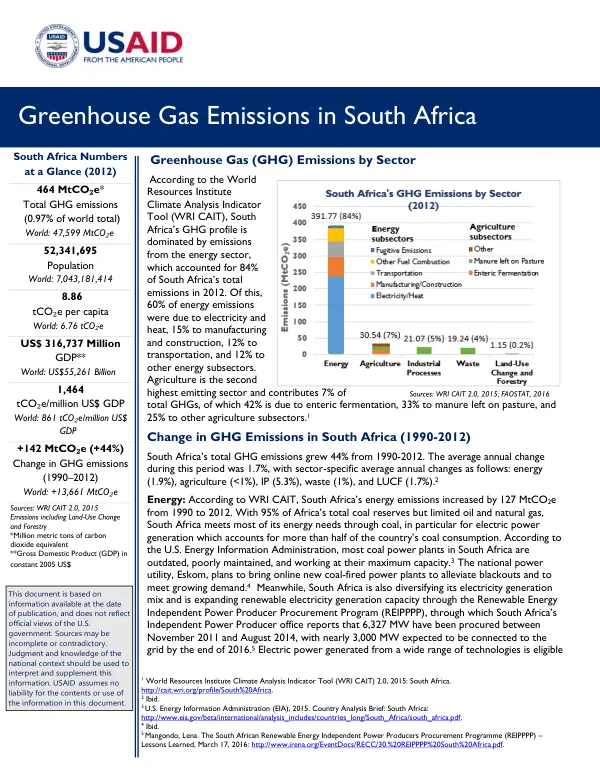
South Africa's greenhouse gas (GHG) emissions profile is dominated by the energy sector, which accounted for 84% of the country's total emissions in 2012.
2012 · 3 pages
Sign in to readA free account is required to download.
Abstract
Within the energy sector, electricity and heat generation was the largest contributor, responsible for 60% of energy emissions. Manufacturing and construction, transportation, and other energy subsectors accounted for 15%, 12%, and 12% of energy emissions, respectively. Agriculture is the second-highest emitting sector, contributing 7% of total GHGs. Enteric fermentation, manure left on pasture, and other agriculture subsectors were responsible for 42%, 33%, and 25% of agriculture emissions, respectively. South Africa's total GHG emissions grew 44% from 1990 to 2012, with an average annual change of 1.7%. The energy sector experienced an average annual growth rate of 1.9%, while agriculture emissions grew at an average annual rate of less than 1%. South Africa's energy emissions increased by 127 MtCO2e from 1990 to 2012, primarily due to the country's reliance on coal for electricity generation. Coal-fired power plants, which account for more than half of the country's coal consumption, are outdated, poorly maintained, and operating at maximum capacity. The national power utility, Eskom, plans to bring online new coal-fired power plants to alleviate blackouts and meet growing demand. However, South Africa is also diversifying its electricity generation mix and expanding renewable electricity generation capacity through the Renewable Energy Independent Power Producer Procurement Program (REIPPPP). As of 2012, 94% of electricity in South Africa was produced from coal, followed by nuclear (5%), hydro (2%), and biofuels and non-hydro renewables (<1%). In 2013, the electricity generation mix had changed slightly, with the percentage of coal-fired generation decreasing to 93%, and nuclear increasing to 6%. Agriculture emissions grew slightly, 0.05 MtCO2e, from 1990 to 2012, but declined by 15.7% from 2000 to 2010 due to reduced emissions from the livestock subsector. South Africa's carbon intensity, measured as GHG emissions relative to gross domestic product (GDP), is relatively high, with a carbon intensity of 1,464 tCO2e/million US$ GDP, compared to the world average of 861 tCO2e/million US$ GDP. The country's energy intensity has resulted in an emissions profile that differs substantially from that of other developing countries at a similar stage of development. South Africa's National Climate Change Response Strategy notes that it is a relatively significant contributor to global climate change, with significant GHG emissions from its energy-intensive, fossil-fuel powered economy. South Africa has set a GHG mitigation target, known as the "peak, plateau and decline" (PPD) emissions trajectory, which aims to peak emissions between 2020 and 2025, plateau for approximately a decade, and then decline in absolute terms. This target is backed by a comprehensive suite of national-level policies, programs, and regulations to address climate change, complemented by sector-specific policies. The country has also been developing policy instruments, including a carbon tax, desired emission reduction outcomes (DEROs) for particular sectors, company-level carbon budgets, and regulatory standards and controls for specific GHG pollutants and emitters.