TETRA TECH
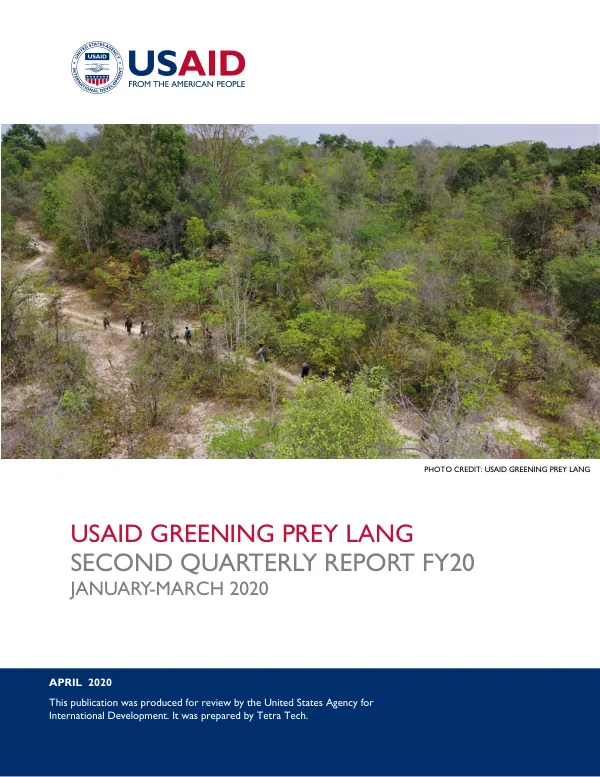
Greening Prey Lang FY20 Quarterly Progress Report Q2
The USAID Greening Prey Lang Activity is a program aimed at improving biodiversity conservation and ecosystem health in the Prey Lang Extended Landscape.
2020 · 77 pages
Sign in to readA free account is required to download.
Abstract
The program is implemented by Tetra Tech, with funding from the United States Agency for International Development (USAID). The geographic focus of the program is the Prey Lang Extended Landscape, which spans across several provinces in Cambodia. The program has three main objectives: improved biodiversity conservation and ecosystem health, increased sustainable and equitable economic opportunities, community livelihoods, and natural capital reinvestment, and strengthened inclusive and effective landscape governance. Objective 1 aims to improve biodiversity conservation and ecosystem health through the establishment of protected areas, community-managed forests, and biodiversity conservation corridors. Objective 2 focuses on increasing sustainable and equitable economic opportunities, community livelihoods, and natural capital reinvestment through the development of sustainable agriculture practices, community fisheries, and community forests. Objective 3 aims to strengthen inclusive and effective landscape governance through the establishment of a community-led governance structure, coordination with local authorities, and engagement with key stakeholders. The program also focuses on management and communications, including administration, project management, and communications and outreach. The program has made significant progress in the second quarter of FY20, with several key achievements reported. These include the establishment of 15 community-managed forests, the development of sustainable agriculture practices for over 2,500 farmers, and the implementation of biodiversity conservation corridors. The program has also engaged with key stakeholders, including local authorities, community leaders, and civil society organizations. The program has also faced several challenges, including limited access to funding, inadequate infrastructure, and limited capacity of local authorities. However, the program has made significant progress in addressing these challenges, including the development of a comprehensive project management plan and the establishment of a community-led governance structure. The program has also reported several key indicators, including the establishment of 15 community-managed forests, the development of sustainable agriculture practices for over 2,500 farmers, and the implementation of biodiversity conservation corridors. The program has also reported several key performance indicators, including the increase in household income among program participants and the improvement in food security indicators. The program has also engaged with several key stakeholders, including local authorities, community leaders, and civil society organizations. The program has also reported several key partnerships, including partnerships with the Cambodian Environment Management Information System-Protected Area Monitoring Platform, the Council for the Development of Cambodia, and the Conservation International. The program has also reported several key activities, including the establishment of community-managed forests, the development of sustainable agriculture practices, and the implementation of biodiversity conservation corridors. The program has also reported several key research results, including the impact of sustainable agriculture practices on household income and food security. The program has also reported several key upcoming activities, including the establishment of additional community-managed forests, the development of sustainable agriculture practices for additional farmers, and the implementation of biodiversity conservation corridors. The program has also reported several key public events, including community meetings and workshops. The program has also reported several key electronic documents and datasets, including project management plans, financial reports, and biodiversity conservation corridor maps. The program has also reported several key activity visual stories, including photos and videos of program activities. The program has also reported several key COVID-19 policies, including policies on social distancing, mask-wearing, and hand hygiene. The program has also reported several key annexes, including a Prey Lang Extended Landscape map, a list of key stakeholders, and a description of next quarter activities.