TETRA TECH
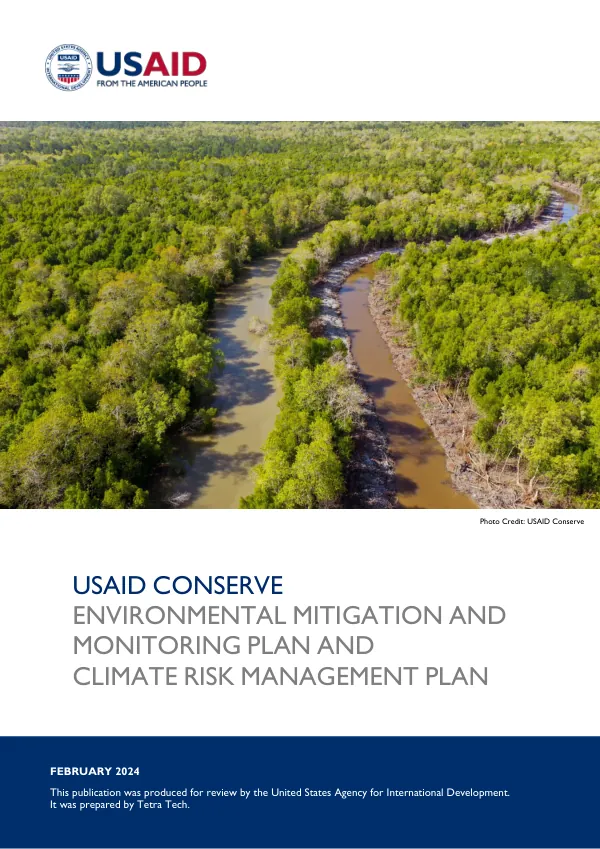
Environmental Mitigation and Monitoring Plan and Climate Risk Management Plan
The USAID Conserve Activity is a five-year initiative aimed at preserving and protecting biodiversity and natural resources in targeted communities in Cambodia.
2024 · 47 pages
Sign in to readA free account is required to download.
Abstract
The Activity seeks to engage and empower communities to safeguard and expand their natural surroundings, including wildlife habitats, and address drivers of deforestation and biodiversity loss across target provinces. Emphasis is placed on increasing community participation in forest management decisions while improving community-based economic development. The Activity will develop and implement a suite of interventions under two objectives, using technical support, advisory services, and Grants Under Contract (GUC). Specifically, it will enhance the effectiveness of natural resource governance practices of key natural resource managers at national, subnational, and community levels to sustainably manage forests, conserve biophysical conditions and wildlife habitats, reduce illegal wildlife trade, and support low emissions development of target areas. The Activity will also improve constructive dialogue on forest management and economic development at the national, subnational, and community levels from conservation-friendly, climate-smart, and socially equitable market systems with private sector actors and natural resource dependent communities. The USAID Conserve Environmental Mitigation and Monitoring Plan and Climate Risk Mitigation Plan (EMMP-CRMP) is a critical component of the Activity, promoting sound environmental management to support Activity achievements with environmental and climate risk management measures. The EMMP-CRMP was finalized based on the determinations and mitigation measures required in the activity's Initial Environmental Examination (IEE). It identifies mitigation actions, monitoring actions, and responsibility and scheduling for mitigation, monitoring, and reporting for specific activities that are subject to the conditions set out in the "Recommended Threshold Decision" section of the IEE. The EMMP-CRMP considers the potential impacts from climate change and presents proposed mitigation and adaptation measures. The plan also identifies how the USAID Conserve team will ensure that IEE conditions applicable to activities supported under sub-contracts and sub-grants will be implemented and regularly reviewed to support adaptive management responsive to evolving conditions. During implementation, USAID Conserve will provide Environmental Review Checklists (ERCs) and Environmental Reporting Forms (ERFs) as needed by specific interventions supported by Activity funds. The USAID Conserve team will integrate the mitigation measures presented into intervention design, implementation, monitoring, and improvement. The team will monitor and document environmental and climate compliance in accordance with the EMMP-CRMP and the IEE threshold decisions. To accomplish this, the USAID Conserve team will use an ERC to evaluate impacts of planned interventions and verify that all planned interventions are within the scope of the IEE. If any interventions are outside the scope of the IEE, the team will work with USAID/Cambodia to receive the required approvals pursuant to 22 CFR 216.3(a)(9). Tetra Tech will build the capacity of the USAID Conserve team and sub-awardees in environmental/climate management and compliance. It will ensure all Activity staff, core implementation partners, and grantees understand and are able to implement the mitigation mechanisms outlined in the EMMP-CRMP. The USAID Conserve team will include environmental/climate compliance language in all its solicitations and awards, encourage partner organizations to adopt environmentally safe and climate-smart processes and practices, and incorporate appropriate environmental and climate risk analyses in their development planning processes. The EMMP-CRMP is intended to cover the life of the Activity, but the team will review and as needed, update the plan to ensure it remains relevant and effective in addressing the environmental and climate risks associated with the Activity. The plan will be an implementable and traceable document that is referenced and used in day-to-day management, and will be integrated into intervention design, implementation, monitoring, and improvement.