ECODIT, INC.
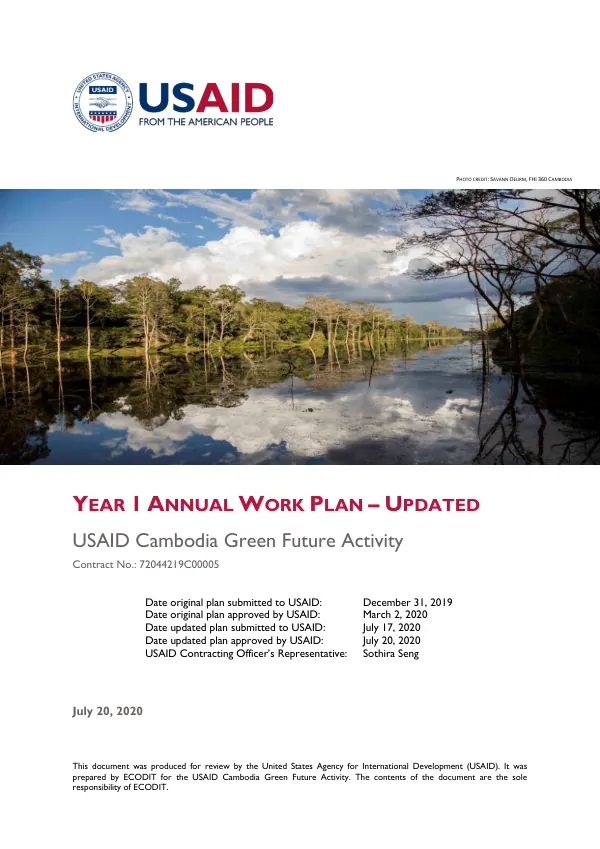
USAID CGFA Year 1 Annual Work Plan - Updated July 2020
The USAID Cambodia Green Future Activity aims to promote sustainable landscapes and biodiversity conservation in Cambodia.
2020 · 28 pages
Sign in to readA free account is required to download.
Abstract
The project focuses on addressing the threats to natural resources, including population growth, lifestyle changes, market demand increases, and climate change. Conservation and civil society organizations have a long history of raising environmental awareness, but efforts have lacked coordination and rigorous methodological approaches. The project targets key populations, including indigenous peoples around the forests of Prey Lang and youth in Phnom Penh. Improved tools and targeted knowledge will strengthen efforts in biodiversity conservation, sustainable landscapes, and governance. The project will work with local communities, civil society organizations, and government agencies to promote sustainable land-use practices, reduce deforestation, and protect biodiversity. The project's theory of change is based on the assumption that improved knowledge, skills, and practices among key populations will lead to behavior change and reductions in threats to natural resources. The project will use a combination of approaches, including community engagement, capacity building, and policy support, to achieve its objectives. The project's target audiences and stakeholders include local communities, civil society organizations, government agencies, and private sector partners. The project will work with these stakeholders to identify and address the root causes of deforestation and biodiversity loss, and to promote sustainable land-use practices. The project's strategic implementation approach will focus on three key areas: sustainable landscapes, biodiversity conservation, and governance. The project will work with local communities to promote sustainable land-use practices, reduce deforestation, and protect biodiversity. The project will also work with government agencies and private sector partners to promote policy and regulatory frameworks that support sustainable land-use practices. The project's cross-cutting issues include gender strategies, youth empowerment, private sector partnerships, and science, technology, innovation, and partnerships (STIP). The project will address these issues through a range of activities, including capacity building, community engagement, and policy support. The project's collaborating, learning, and adapting approach will focus on building partnerships and collaborations with local communities, civil society organizations, and government agencies. The project will also use a range of monitoring and evaluation tools to track progress and identify areas for improvement. The project's environmental compliance and climate risk assessment will focus on ensuring that the project's activities are environmentally sustainable and do not contribute to climate change. The project will also work with government agencies and private sector partners to promote policy and regulatory frameworks that support environmental sustainability and climate change mitigation. The project's marking and branding approach will focus on promoting the project's brand and identity, and on building a strong reputation for the project. The project will use a range of marketing and communication tools to promote the project's activities and achievements. The project's timeline for project activities and deliverables is outlined in the detailed work plan for year 1. The project's major upcoming tasks and events include the completion of the detailed work plan, the establishment of partnerships and collaborations with local communities, civil society organizations, and government agencies, and the promotion of policy and regulatory frameworks that support sustainable land-use practices. The project's staffing plan includes a range of personnel, including a chief of party, a home office project manager, and a range of technical staff. The project's technical assistance and international travel plan includes a range of activities, including training and capacity building, and the provision of technical assistance to local communities and government agencies. The project's summary budget for year 1 is outlined in the detailed work plan. The project's appendices include a range of supporting documents, including the project's contract, the project's performance work statement, and the project's memorandum of understanding.
Related documents