CONSERVATION INTERNATIONAL FOUNDATION
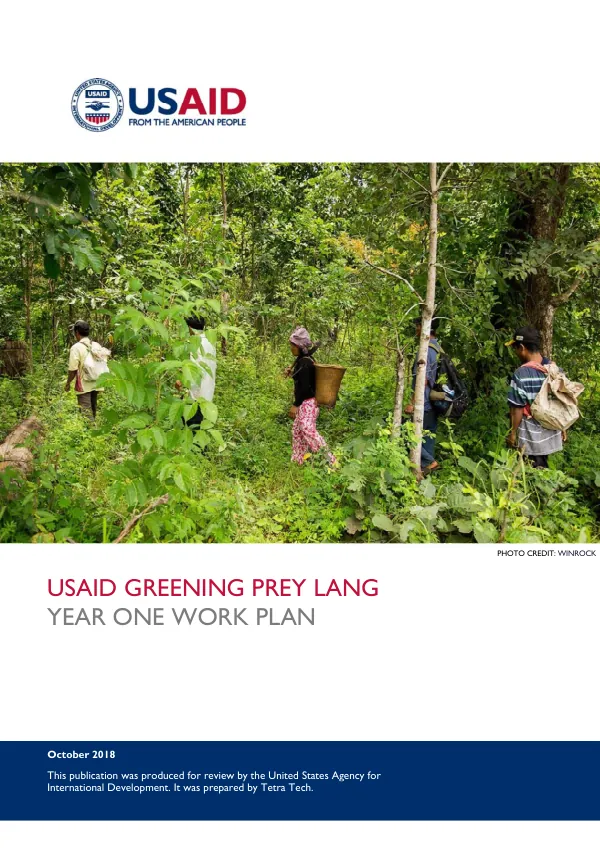
USAID Greening Prey Lang Activity: Year One Work Plan
The USAID Greening Prey Lang activity is a five-year initiative funded by the United States Agency for International Development (USAID) that began on August 13, 2018.
2018 · 33 pages
Sign in to readA free account is required to download.
Abstract
The activity aims to promote resilient, low-emission development and inclusive, sustainable management of the Prey Lang extended landscape (PLEL). Led by Tetra Tech, the activity is supported by two major partners, the Wildlife Conservation Society (WCS) and Conservation International (CI). The PLEL is a critical ecosystem that provides ecological services such as clean air and water, biodiversity, and food to local communities. The activity's goal is to promote resilient, low-emissions development through inclusive sustainable management of the PLEL. To achieve this, the activity provides technical assistance for sustainable landscape management and biodiversity conservation to beneficiaries who depend on ecological services, community-based organizations, the private sector, and the Royal Government of Cambodia (RGC). The activity also supports Cambodia's goals and international commitments for climate change mitigation and biodiversity conservation in the PLEL. The activity is organized to achieve three primary objectives: NATURE, WEALTH, and POWER. The NATURE objective aims to improve biodiversity conservation and ecosystem health in the PLEL. The WEALTH objective seeks to increase sustainable and equitable economic opportunities, community livelihoods, and natural capital reinvestment. The POWER objective aims to strengthen inclusive and effective landscape governance. These objectives collectively contribute to achieving the desired Theory of Change, which includes improved natural resource governance, increased economic opportunities for both men and women, and effective management of natural resources and ecosystem services. The activity will initially focus geographically on the Preah Vihear, Kampong Thom, Kratie, and Steung Treng Provinces. USAID Greening Prey Lang builds on the successes of prior investments in the PLEL, including the USAID-funded Supporting Forests and Biodiversity Project, to improve forest and biodiversity management practices, promote environmentally friendly livelihood activities, and support development of policy instruments addressing climate change and/or biodiversity conservation. The activity will implement the PLEL Vision, which aims to conserve and sustainably manage the PLEL, promote environmentally friendly livelihood activities, and support development of policy instruments addressing climate change and/or biodiversity conservation. The activity will work in close partnership with the Ministry of Environment (MoE); Ministry of Agriculture, Forestry, and Fisheries; and Ministry of Interior. The activity will also engage civil society and public entities to work together to consolidate the conservation and sustainable management of the PLEL. The Year One Work Plan submission is accompanied by the submission of the Monitoring, Evaluation, and Learning (MEL) Plan; Gender and Social Inclusion (GESI) Strategy and Plan; Communication and Outreach Strategy; and Environmental Mitigation and Monitoring Plan and Climate Risk Management Plan. The Year One Work Plan covers the 12-month period beginning October 1, 2018, and ending September 30, 2019.